View High-Res Still Frame
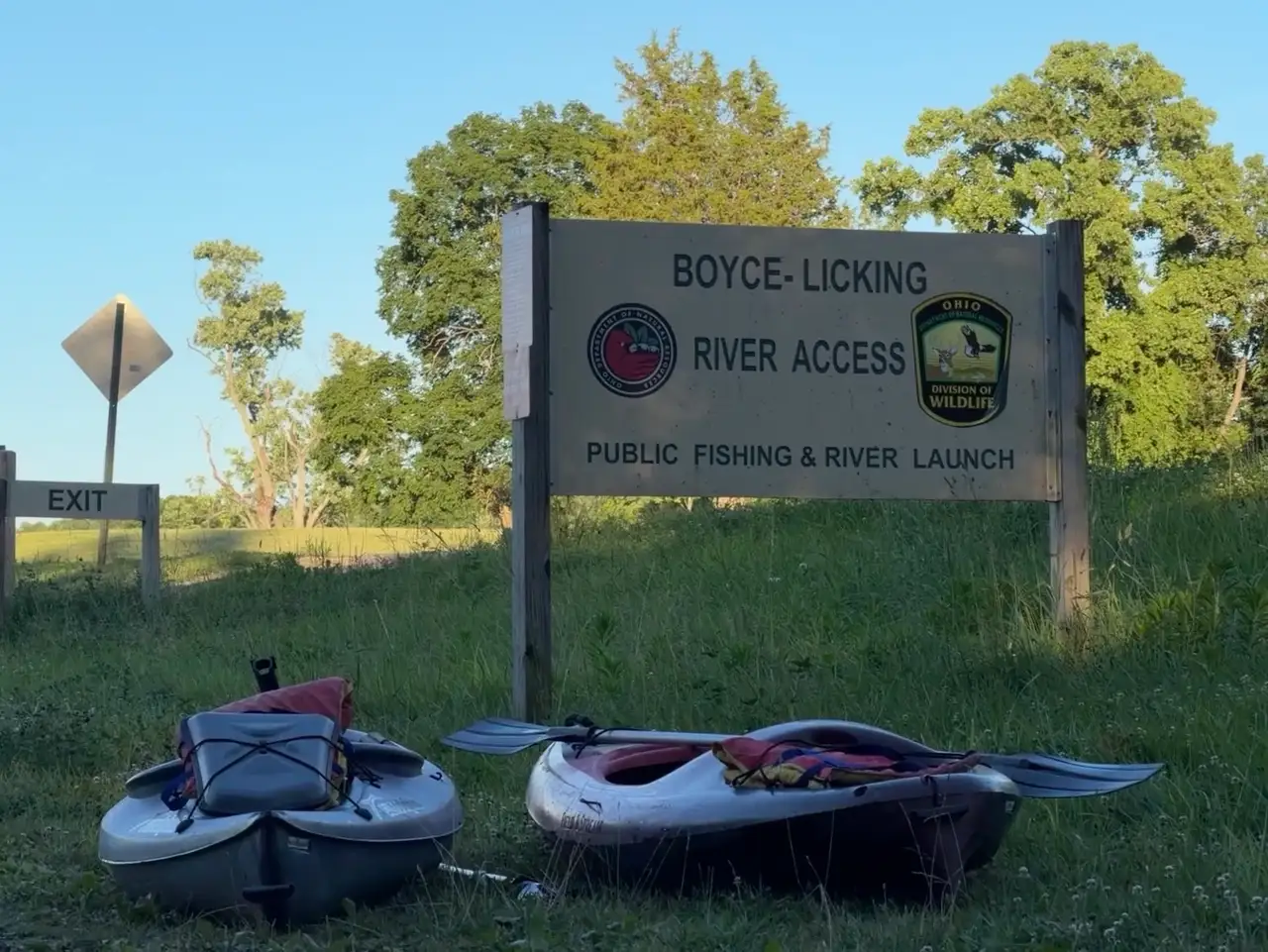
Adventure awaits at the Boyce-Licking River access.
The photograph presents a low-angle, eye-level perspective of two recreational kayaks resting on a grassy incline beside a weathered wooden information sign, bathed in the warm, soft light of what appears to be a golden hour. Licensable...
Read Full Description
The photograph presents a low-angle, eye-level perspective of two recreational kayaks resting on a grassy incline beside a weathered wooden information sign, bathed in the warm, soft light of what appears to be a golden hour. The focal plane is sharp on the kayaks and the primary sign in the mid-ground, while the background elements exhibit a pleasing, smooth bokeh. In the immediate foreground, a dense carpet of unkempt, verdant green grasses, primarily common lawn grass species like Kentucky bluegrass (Poa pratensis) and fescue (Festuca sp.), interspersed with broadleaf weeds such as white clover (Trifolium repens) and dandelions (Taraxacum officinale), rises gently from the bottom edge of the frame. The individual blades of grass display varying shades of spring green and olive green, with some lighter, sun-kissed tips. The two kayaks are the central subjects, positioned just right of center. The kayak on the left is a single-person recreational model, rendered in a muted silver-gray, almost metallic sheen, with a pronounced keel and wide beam. It is laden with a dark charcoal gray dry bag secured by black bungee cords, its contents faintly visible, suggesting emergency supplies or personal effects. A small amount of scarlet fabric, possibly from a life vest or an additional bag, peeks out from beneath the bungee net. To the right, a second kayak, a slightly larger tandem or solo model, lies partially obscured, displaying a primary color of off-white or light tan with subtle burnt sienna or rust-colored accents along its sides. A black paddle, constructed from plastic blades and an aluminum shaft, rests across its cockpit, its blades extended towards the right. A folded life vest, a vibrant blend of scarlet and amber yellow, is tucked into the cockpit of this second kayak, suggesting preparedness for water activities. Dominating the mid-ground is a rectangular, pale khaki-colored wooden sign, mounted on two weathered, dark brown wooden posts. The sign displays prominent black lettering: “BOYCE-LICKING RIVER ACCESS” at the top, and “PUBLIC FISHING & RIVER LAUNCH” below. Embedded within the sign are two circular emblems: the left, for the “Ohio Department of Natural Resources,” features a stylized red, white, and blue design with a buck's head and a map of Ohio. The right emblem, for the “Ohio Division of Wildlife,” depicts a deer, a duck in flight, and a fish against a deep forest green and gold background. To the far left, a smaller, weathered wooden sign on a similar post reads “EXIT” in black block letters, positioned below a white, diamond-shaped warning sign with no visible markings or symbols, only its stark, reflective surface catching the golden light. The background is filled with a mixture of mature deciduous trees, likely a mix of species such as various oak (Quercus sp.) and maple (Acer sp.) trees, identifiable by their full, rounded canopies and various shades of deep forest green foliage. Among them, particularly towards the left mid-background, are trees with a slightly more conical shape and darker, denser green, possibly indicating Eastern Red Cedar (Juniperus virginiana) or other coniferous species. The bark texture of the deciduous trees, where visible through the leaves, appears furrowed. The clear, cerulean blue sky, largely devoid of clouds, fills the upper portion of the frame, hinting at a warm and pleasant outdoor environment. The overall impression is one of serene recreational readiness in a natural, riparian setting. No discernible insects or animals are visible, beyond the implied presence of wildlife on the Ohio emblems.