View High-Res Still Frame
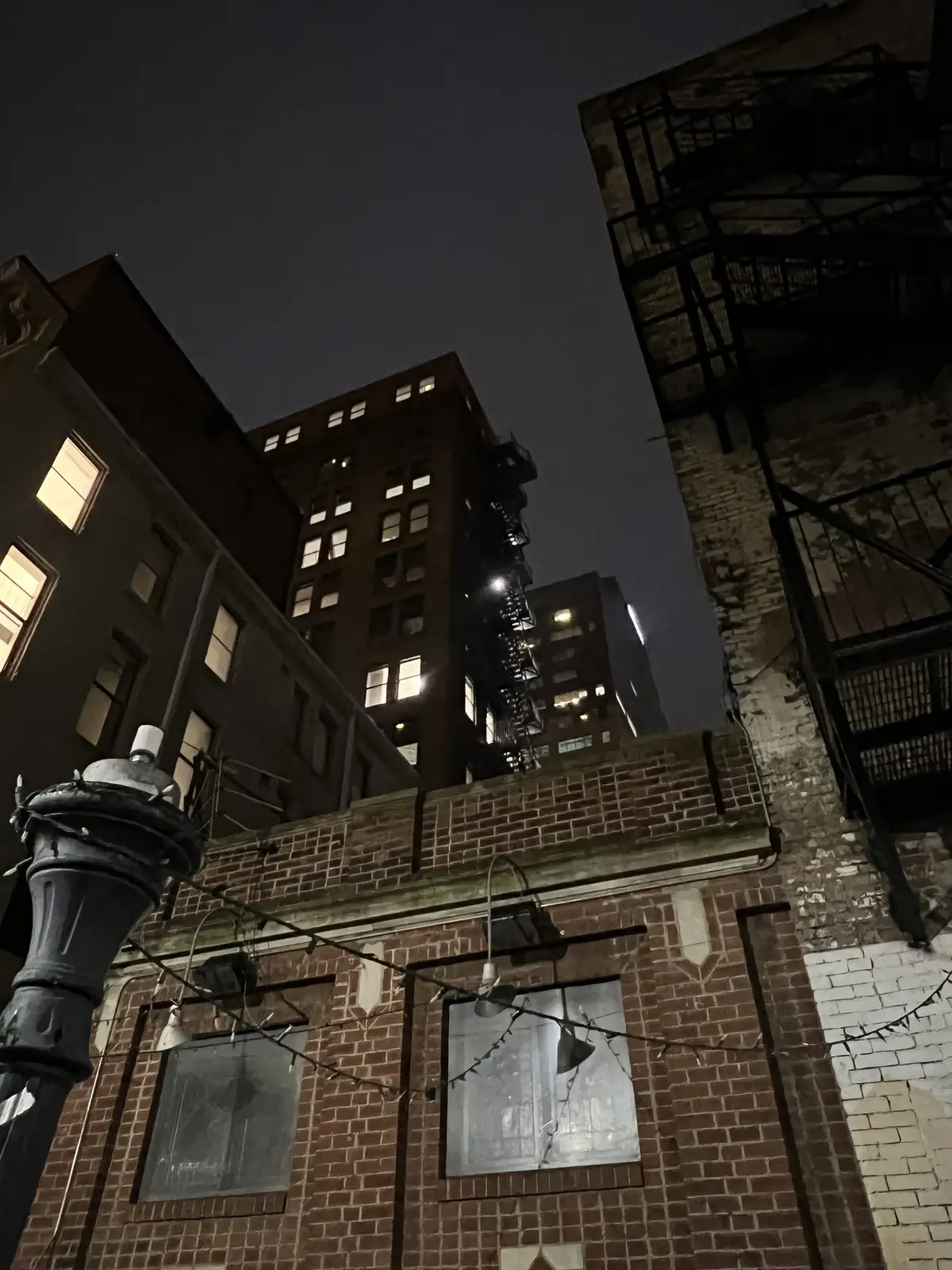
Urban grit meets night's soft glow.
An upward-looking, low-angle photograph captures a quintessential urban alleyway scene at night, dominated by the towering silhouettes of historic and modern buildings under a deep, velvety indigo sky. Licensable motion asset by Dylan...
Read Full Description
An upward-looking, low-angle photograph captures a quintessential urban alleyway scene at night, dominated by the towering silhouettes of historic and modern buildings under a deep, velvety indigo sky. In the immediate foreground, a robust brick wall stretches horizontally across the lower third of the frame. This wall is constructed of reddish-brown common bond brickwork, exhibiting signs of age and weathering, with a muted, slightly reflective sheen from ambient light. Atop the brick, a substantial horizontal coping, likely of concrete or stone, is heavily streaked and encrusted with vibrant lime-green and olive-drab biological growth, consistent with a mix of common urban algae (e.g., *Trentepohlia*) and various mosses (e.g., *Bryum argenteum* or *Ceratodon purpureus*), indicating persistent dampness and low light. Directly below this coping, a series of taut, thin wires support multiple strings of small, exposed-filament incandescent lights, casting warm, amber-hued pinpricks of light. Below these, two industrial-style pendant lamps with dull silver-gray, bell-shaped metal shades extend from gooseneck arms affixed to the wall, each emitting a soft, warm yellow-white glow upwards onto the underside of the coping. Beneath these fixtures, two large, dark, rectangular windows are visible, their panes reflecting the dim ambient light with cool, bluish tones, suggesting a wet or highly reflective surface. The brickwork surrounding these windows features subtle architectural recesses or pilasters. Rising in the midground, directly behind the foreground wall, are the lower stories of a multi-story building, likely an early 20th-century commercial or mixed-use structure, possibly displaying simplified Chicago School or early modern stylistic elements, rendered in a dark, indeterminate material (perhaps stone or pre-cast concrete) by the night. To the far right, a narrow vertical slice of an older, possibly late 19th-century industrial or tenement building, constructed of common red-brown brick, is heavily weathered, showing areas of spalling brick and exposed, deteriorating mortar. A dark, oxidized, multi-tiered external fire escape, likely wrought iron or steel, ascends this structure, its rectilinear forms creating a stark silhouette against the darker sky. The central background is dominated by a majestic, multi-story building, an archetypal early 20th-century commercial or residential high-rise, possibly in a Beaux-Arts or Neo-Classical revival style, characterized by its imposing facade of deep red-brown masonry. Its numerous, regularly spaced rectangular windows form a grid, many brightly illuminated with a warm, golden-yellow light, indicating active occupancy. A prominent, dark, oxidized steel fire escape is visibly attached to its side, providing a strong linear element. Further to the right and slightly behind this primary background building, a taller, more contemporary structure, with a lighter, less detailed facade, rises, featuring a striking vertical strip of cool white or bright electric-blue light, indicative of a modern commercial sign or architectural illumination. The night sky overhead is a deep indigo, subtly transitioning to a softer violet-gray towards the visible horizon line of the buildings, with faint, almost imperceptible wisps of high cirrus or cirrostratus clouds. The photographic perspective is a sharp, dramatic low-angle shot, accentuating the verticality and imposing scale of the urban environment. The depth of field is substantial, maintaining reasonable sharpness from the foreground brickwork to the distant buildings, imparting an immersive sense of urban density. The overall mood is one of quiet, contemplative urban solitude, imbued with a hint of mystery and the enduring presence of architectural history.