Read Full Description
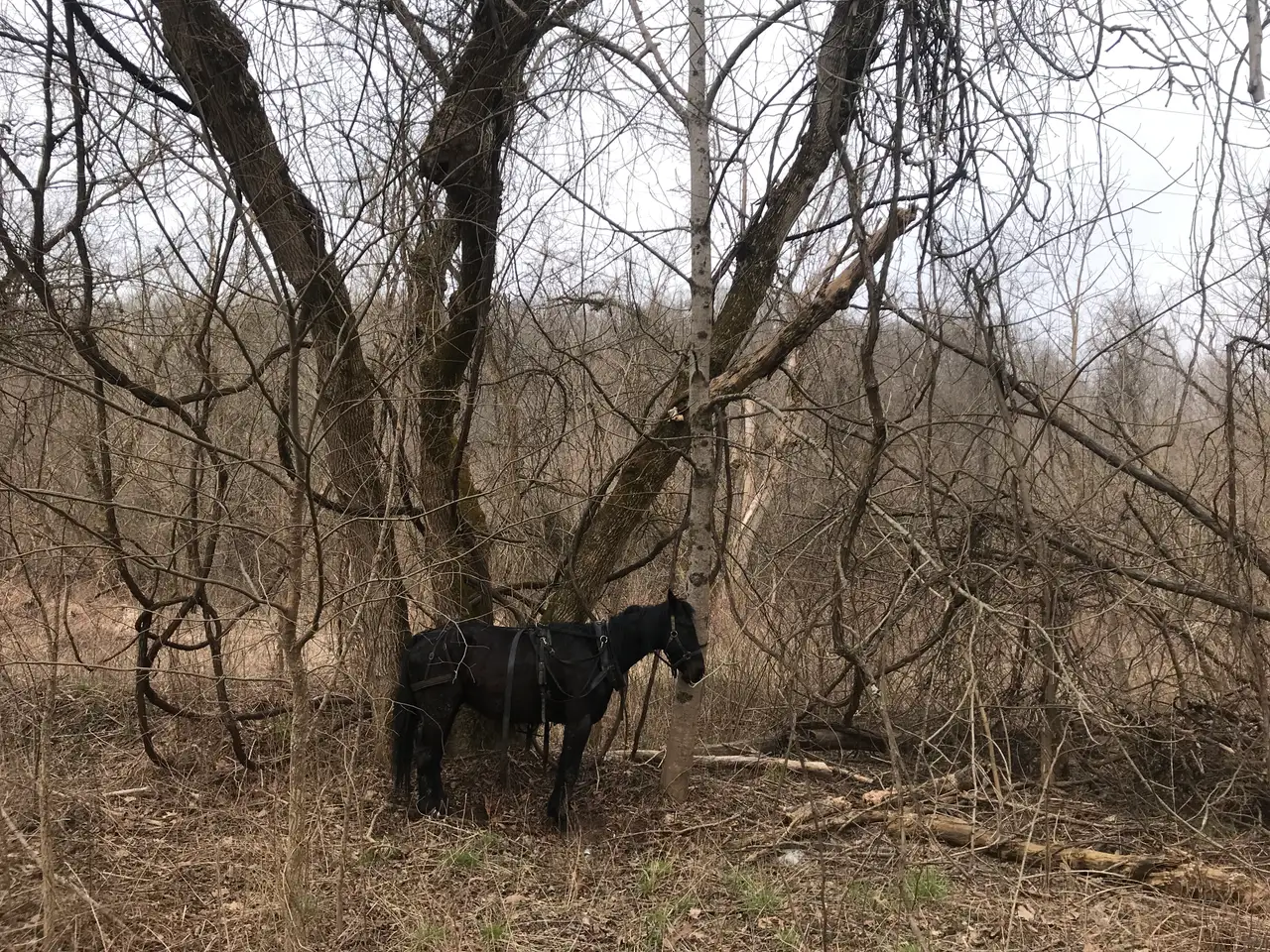
The image captures a solitary, dark-coated horse standing amidst a dense, deciduous forest, likely in late winter or early spring, given the absence of leaves on the trees. The perspective is a slightly low-angle eye-level shot, placing the viewer directly into the woodland scene. The focal plane is centered on the horse, which stands in the midground, its form sharp and clear, while the intricate network of branches in the foreground and background maintains a good degree of sharpness, suggesting a moderate depth of field rather than a shallow bokeh. In the center-left of the frame, a mature domestic horse (Equus caballus) stands facing slightly to the right, its head lowered gently. Its coat is a deep charcoal black, appearing almost velvety in the soft, diffused light of an overcast day. A bridle and reins, appearing to be made of dark brown or black leather, are visible on its head and draped over its back, indicating it is not a wild horse. The horse’s mane and tail, also dark, are subtle against its body. The ground beneath the horse is a rich tapestry of decomposing leaf litter, primarily comprised of desiccated, curled oak leaves (Quercus spp.) and maple leaves (Acer spp.), rendered in various shades of burnt sienna, tawny brown, and muted ochre. Interspersed are numerous small twigs and branches. The forest itself is a complex, almost impenetrable thicket of bare, deciduous trees. Dominating the midground and extending into the background are several mature trees, possibly various species of oak (Quercus spp.) or maple (Acer spp.), their trunks displaying deeply furrowed, grey-brown bark. From these larger trees, and countless smaller, younger saplings, a chaotic yet beautiful tangle of slender, leafless branches radiates upwards and outwards, creating a dense, interwoven screen against the muted, pale grey sky. No discernable specific species of mosses or fungi are visible on the tree trunks or forest floor, though the damp, cool conditions typical of an overcast woodland suggest their potential presence. The overall color palette is dominated by earthen tones – various browns, grays, and muted greens from dormant undergrowth – creating a serene, somewhat melancholic atmosphere. The soft, ambient light casts minimal, indistinct shadows, emphasizing the textures of the bark and the horse's coat. No human structures, signs, or text are visible.