View High-Res Still Frame
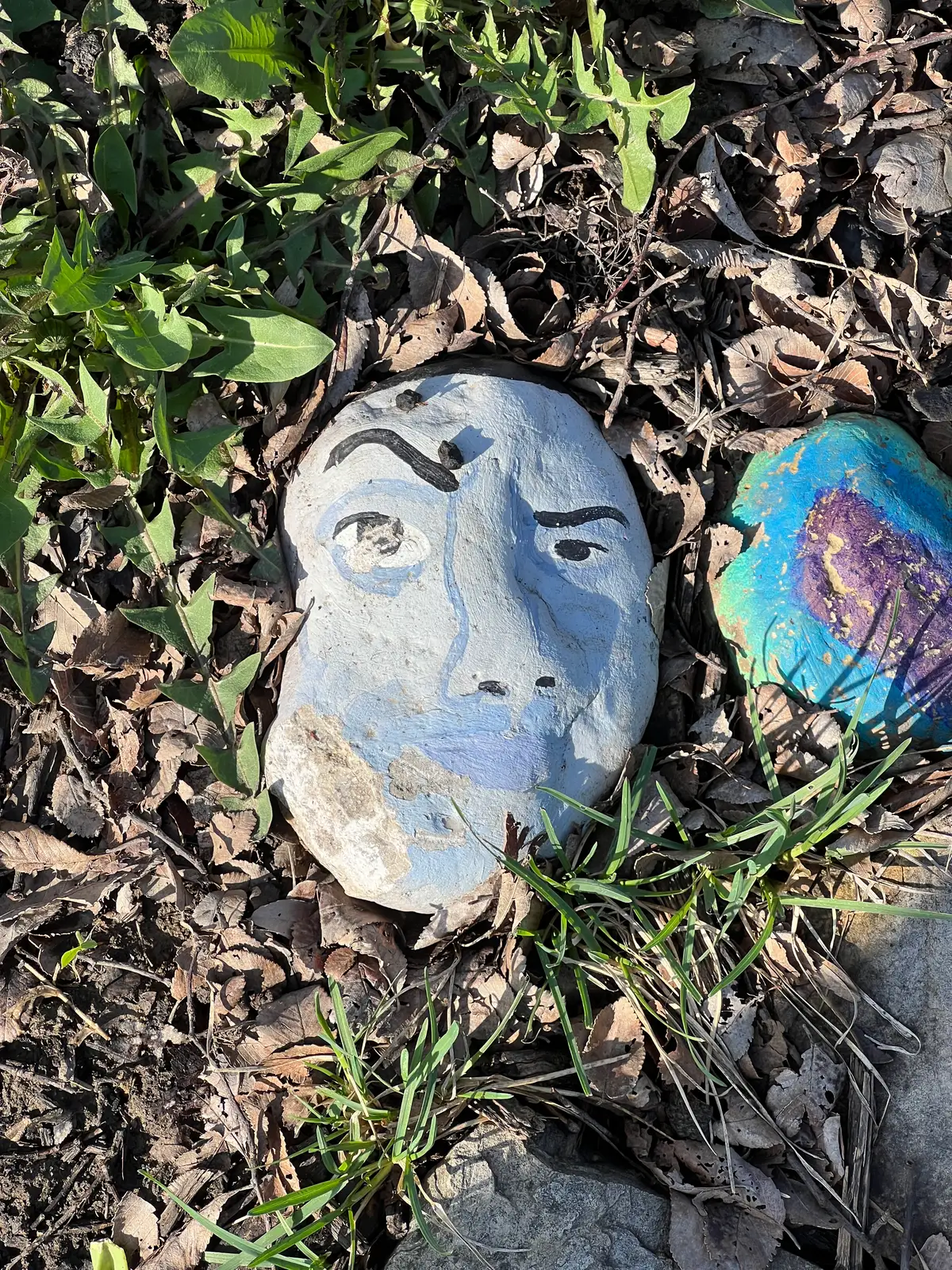
Found a curious face in the wild.
A vibrant, high-angle close-up photograph captures an irregularly shaped, natural stone, approximately 18-20 cm in length, meticulously painted with a stylized human face, positioned amidst a mosaic of natural ground cover. Licensable...
Read Full Description
A vibrant, high-angle close-up photograph captures an irregularly shaped, natural stone, approximately 18-20 cm in length, meticulously painted with a stylized human face, positioned amidst a mosaic of natural ground cover. The central rock, likely a river stone smoothed by erosion, presents a predominantly periwinkle blue skin tone with subtle lavender and pale sky blue undertones, exhibiting minor chipping that reveals the natural gray-beige of the underlying stone. The face features a large, expressive left eye with a distinct charcoal gray pupil set against a bright white sclera, crowned by a thick, arched, ink-black eyebrow. The right eye is portrayed with a heavy, shaded lid, creating an asymmetrical, contemplative, or quizzical expression, further emphasized by a similarly thick black brow that extends into a dark, swooping stroke on the upper-left corner of the rock, suggestive of hair. A delicate, narrow charcoal gray line defines the nose, while the small, downturned lips are painted in a muted lavender or pale purple, imparting a pensive or melancholic air. To the immediate right of the primary subject, a smaller, more rounded natural stone is partially visible, adorned with abstract splotches of vivid turquoise, deep indigo, and streaks of magenta or dark violet, resembling a stylized natural form or an artistic accent. Both painted stones are nestled on a substrate composed of a rich tapestry of decaying deciduous leaves and emergent green flora. The leaves, primarily identified as weathered oak leaves (Quercus species) due to their characteristic lobed structure, display a palette of burnt sienna, sepia brown, and desiccated dark amber, indicative of late autumn or early winter shedding; many are curled and brittle. Interspersed among these fallen leaves are slender, upright blades of fresh spring green grass, likely Kentucky bluegrass (Poa pratensis) or a fescue (Festuca species), alongside broader, dark forest green leaves of common broadleaf weeds, potentially plantain (Plantago major), signaling active new growth. Smaller, unpainted natural stones are subtly integrated into the ground cover, supporting the main subjects. The scene is illuminated by clear, direct natural sunlight from a high angle, casting short, crisp shadows that underscore the contours of the rocks and individual blades of grass, suggesting a bright, unclouded late morning or early afternoon. The atmosphere appears dry and clear, devoid of any visible humidity. The camera's perspective is slightly elevated, looking down onto the ground, with a shallow depth of field precisely focusing on the painted face rock. The foreground and background exhibit a gentle, creamy bokeh, softly blurring the surrounding leaves and foliage into an indistinct wash of greens and browns, effectively isolating and emphasizing the artistic focal point. There is no readable text, signage, or discernible man-made architecture visible.