Read Full Description
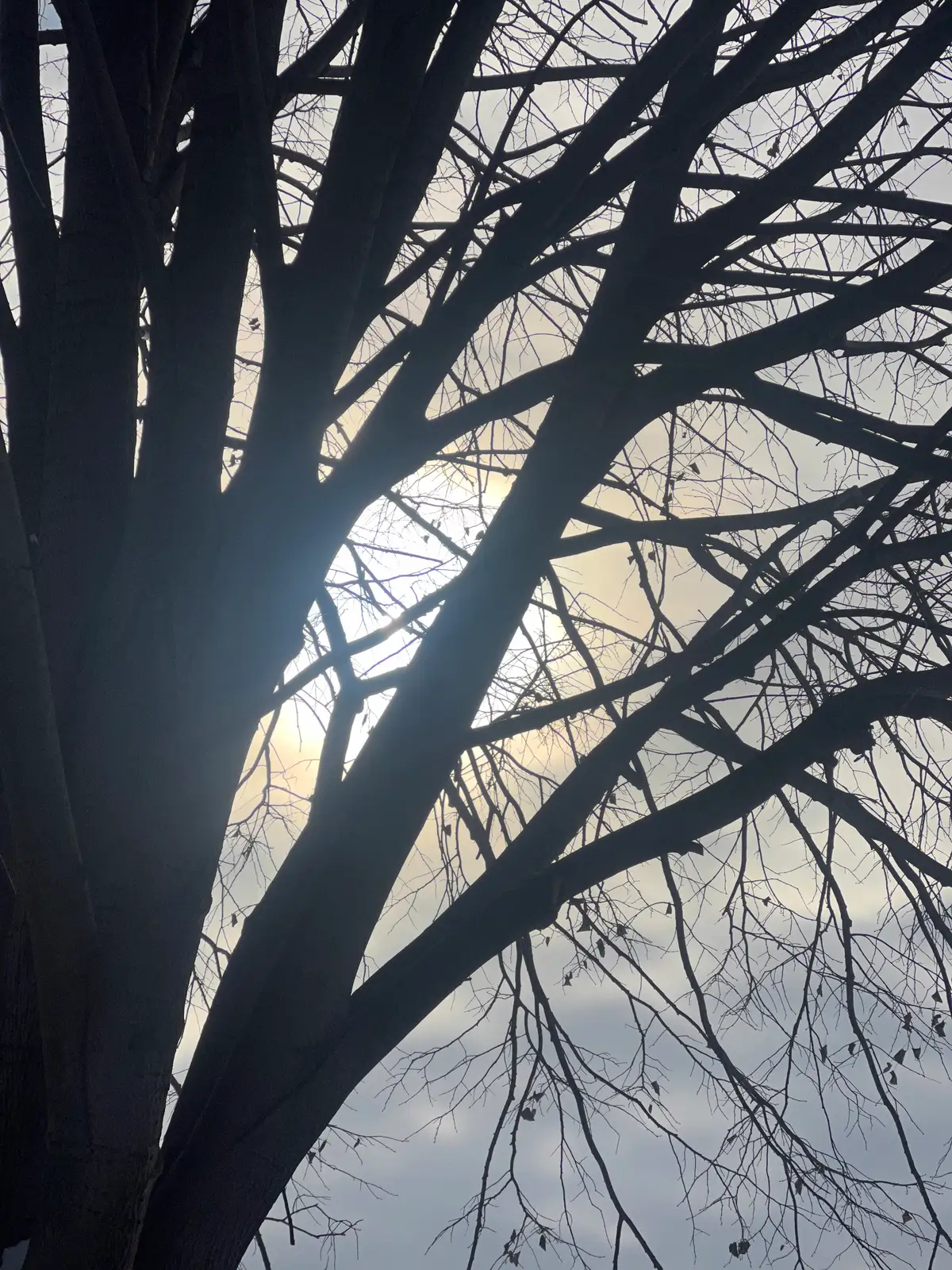
A vertical, low-angle photograph captures the dramatic, intricate silhouette of a large, mature deciduous tree, completely bare of leaves, against a brilliantly bright, overcast sky. The tree's main trunk, positioned prominently on the left side of the frame, is rendered in a deep charcoal grey, almost black, due to the intense backlighting. Its implied bark texture, though softened by the silhouette, suggests a furrowed or rough surface typical of older deciduous trees. From the trunk, a complex network of thick primary branches and slender, intertwining secondary branches extends dynamically across the entire frame, creating an organic, abstract pattern of dark, sinuous lines against the luminous background. No specific species of deciduous tree (e.g., oak (Quercus), maple (Acer), birch (Betula)) can be definitively identified, nor are there any visible insects, birds (Aves), fungi, or other organisms on its branches or in the sky. The tree appears to be in its dormant stage, characteristic of late autumn or winter. The sun, an intense point of light, is positioned in the upper-mid section of the frame, partially obscured by several prominent branches. It emits a brilliant, almost pure white glow with subtle hints of pale yellow and muted gold, suggesting a powerful light source attempting to pierce through an overcast sky. This direct backlighting creates a significant lens flare and a soft halo of diffused light, or atmospheric haze, around the sun. The surrounding sky is a lighter grey-blue, transitioning to a medium grey-blue towards the bottom right edge, indicative of a uniformly cloudy or hazy day. The camera's perspective is looking sharply upwards, placing the viewer beneath the sprawling canopy. The depth of field appears relatively deep, keeping the entire intricate branch structure in sharp focus against the uniformly bright and diffused sky. There are no readable texts, signs, or architectural elements visible in the image.