Read Full Description
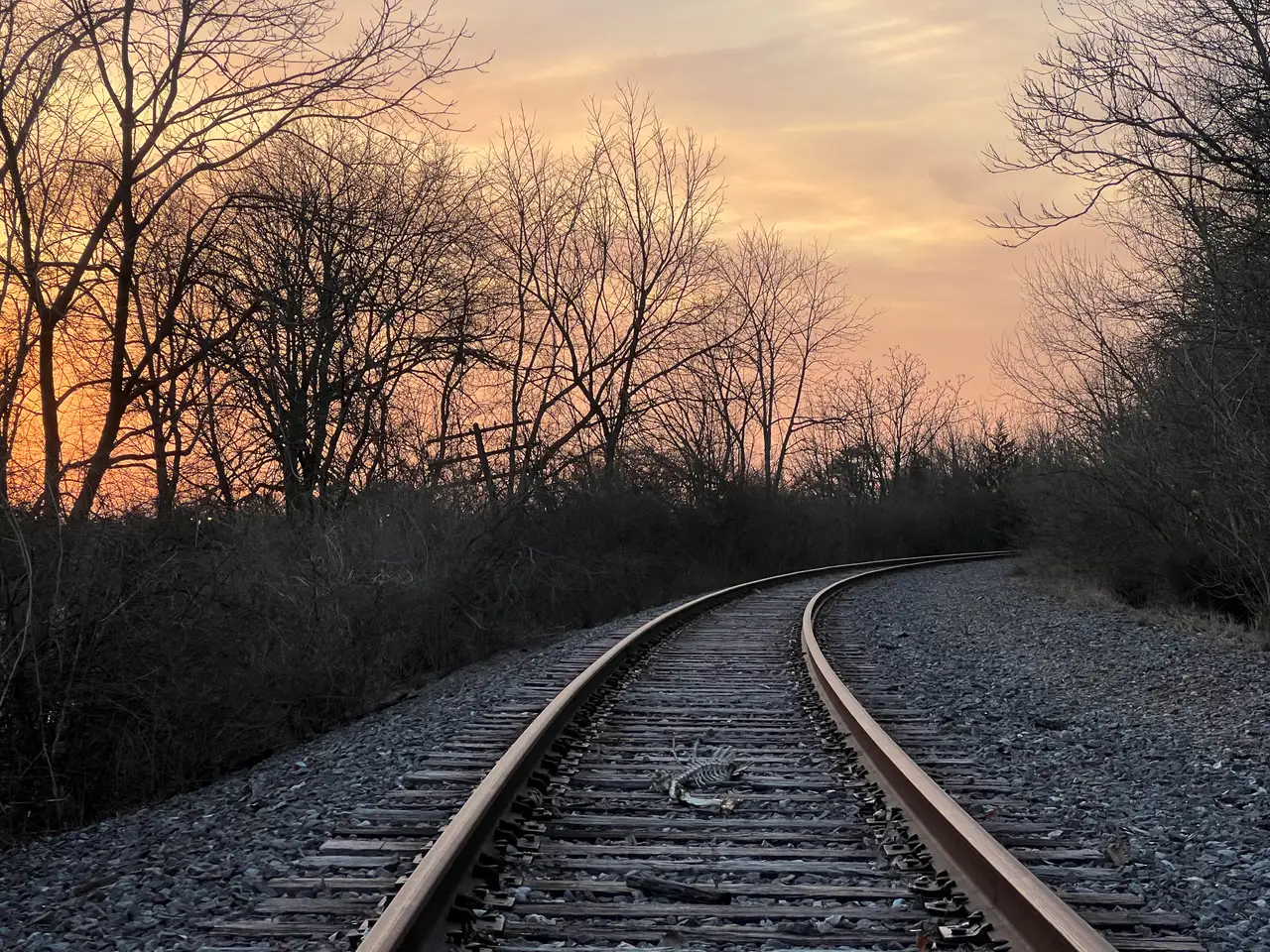
A tranquil, low-angle photograph captures a set of abandoned or rarely used railroad tracks curving gently towards the right, receding into a distant horizon under a dramatic, warm-toned sky. Two parallel, rusty ferrous metal rails, exhibiting a deep reddish-brown patina, stretch from the immediate foreground. These rails are secured by numerous weathered, dark timber sleepers (also known as ties), which are evenly spaced and partially embedded in a bed of crushed, angular grey stone ballast, likely granite or basalt aggregate, forming the track bed. Roughly in the mid-ground, a crumpled piece of white, slightly translucent plastic or synthetic fabric debris is visible lying between the two rails. Both sides of the track are flanked by dense, dormant deciduous trees and thick undergrowth. The trees, mostly bare of foliage, with intricate networks of dark, gnarled branches, are silhouetted against the vibrant sky. These could be various species of oak (Quercus spp.), maple (Acer spp.), or ash (Fraxinus spp.) in their winter or early spring state. The shrubbery, particularly dense on the left, forms an indistinct, dark mass, suggesting species like multiflora rose (Rosa multiflora) or various privets (Ligustrum spp.). The sky, a dominant feature of the background, displays a gradient of warm, soft colors characteristic of golden hour: a vivid marigold orange at the horizon line, transitioning upwards through delicate rose pinks to a subtle, pale celadon green-blue at the very top. Thin, wispy cirrus clouds are subtly illuminated. The lighting is soft and ambient, primarily backlighting from the unseen sun just below the horizon, casting the trees into stark silhouettes and giving the upper surfaces of the rails a faint, warm amber sheen. The camera perspective is low, eye-level with the tracks, creating strong leading lines that draw the viewer's eye deep into the frame. The focal plane appears to be set on the tracks in the mid-ground, with a shallow depth of field causing a gentle bokeh effect that blurs the distant trees and the very immediate foreground ballast. The scene evokes a cool, calm atmosphere, indicative of late autumn, winter, or early spring.