Read Full Description
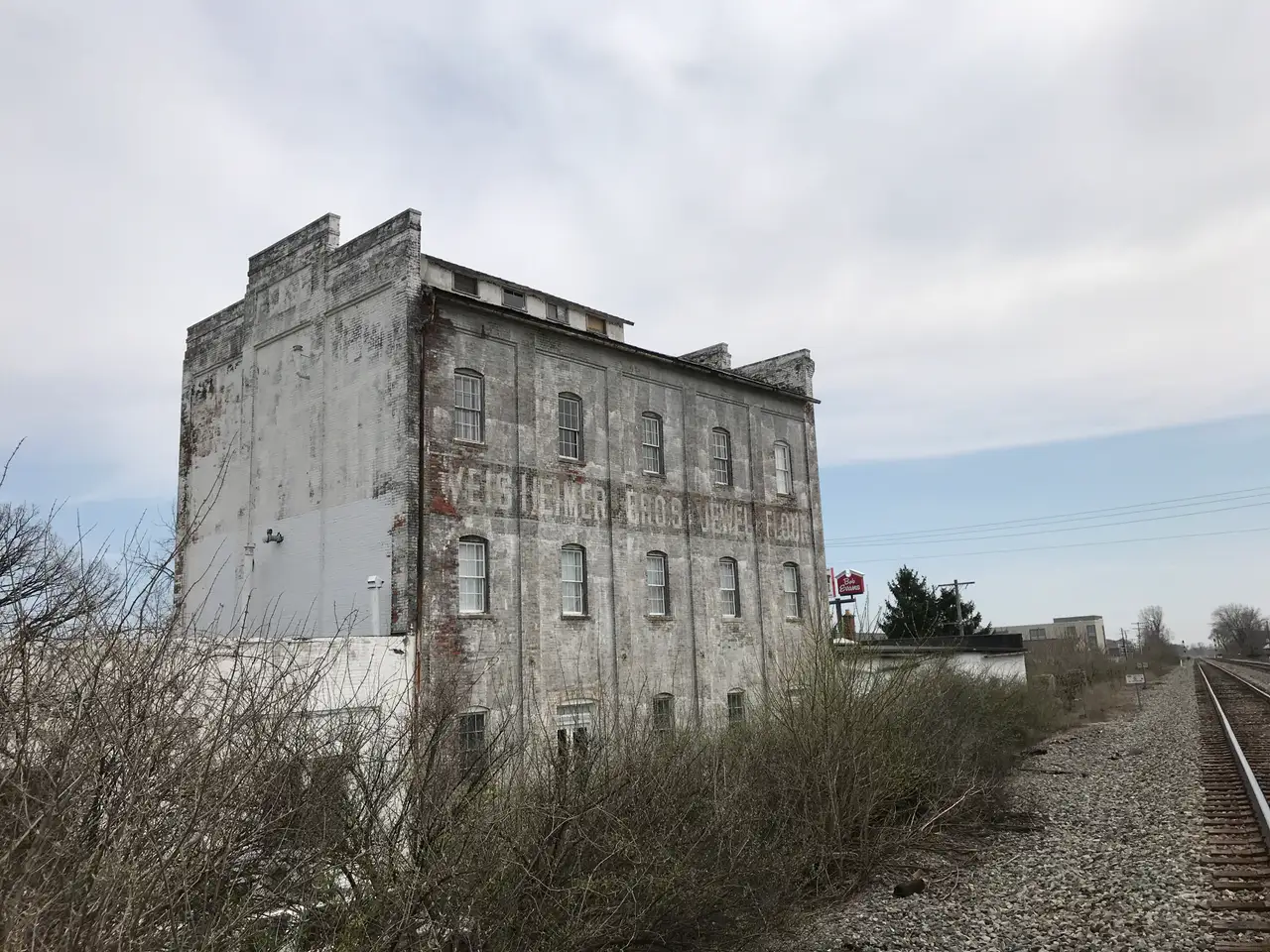
An outdoor, slightly low-angle, wide-shot photograph captures a derelict three-story brick building, heavily obscured by weathered paint and foreground vegetation, situated alongside a set of railroad tracks under an overcast sky. The building, likely dating from the late 19th or early 20th century, exhibits a utilitarian architectural style with elements of vernacular commercial design. Its primary facade, facing left in the frame, is constructed of reddish-brown common brick, almost entirely covered in peeling, faded off-white to pale gray paint that reveals large patches of the underlying burnt sienna and ochre-toned brickwork. Remnants of a decorative cornice or parapet capping are visible at the roofline, above a series of rectangular, double-hung windows with opaque or covered panes, spaced unevenly. Raised, faded lettering, possibly spelling 'VELVET' or a similar word, is barely discernible on the upper stories of the facade. To the right of the building, and extending into the foreground, a dense thicket of bare deciduous shrubs, likely common invasive species such as Amur honeysuckle (Lonicera maackii) or common privet (Ligustrum vulgare), presents an intricate network of thin, sinuous, reddish-brown to sepia-toned branches, devoid of foliage, indicative of late winter or early spring. The ground beneath these shrubs consists of dry, pale brown stalks of unidentifiable grasses (Poaceae family) mixed with dark, loose soil. Further to the right, two parallel steel railroad tracks, dark gray with hints of rust, recede into the background. They are supported by dark brown wooden sleepers (ties) embedded in a bed of light gray to tan crushed gravel ballast, composed of small igneous rock aggregates. The sky is predominantly overcast, filled with a diffused tapestry of pale gray and muted white clouds, with faint hints of pale cerulean blue peeking through along the horizon on the far right. Distant, indistinct bare trees and a utility pole with power lines are faintly visible beyond the tracks. The lighting is soft and even, characteristic of an overcast day, producing no harsh shadows. The depth of field is relatively deep, keeping both the foreground vegetation and the midground building in reasonable focus.