Read Full Description
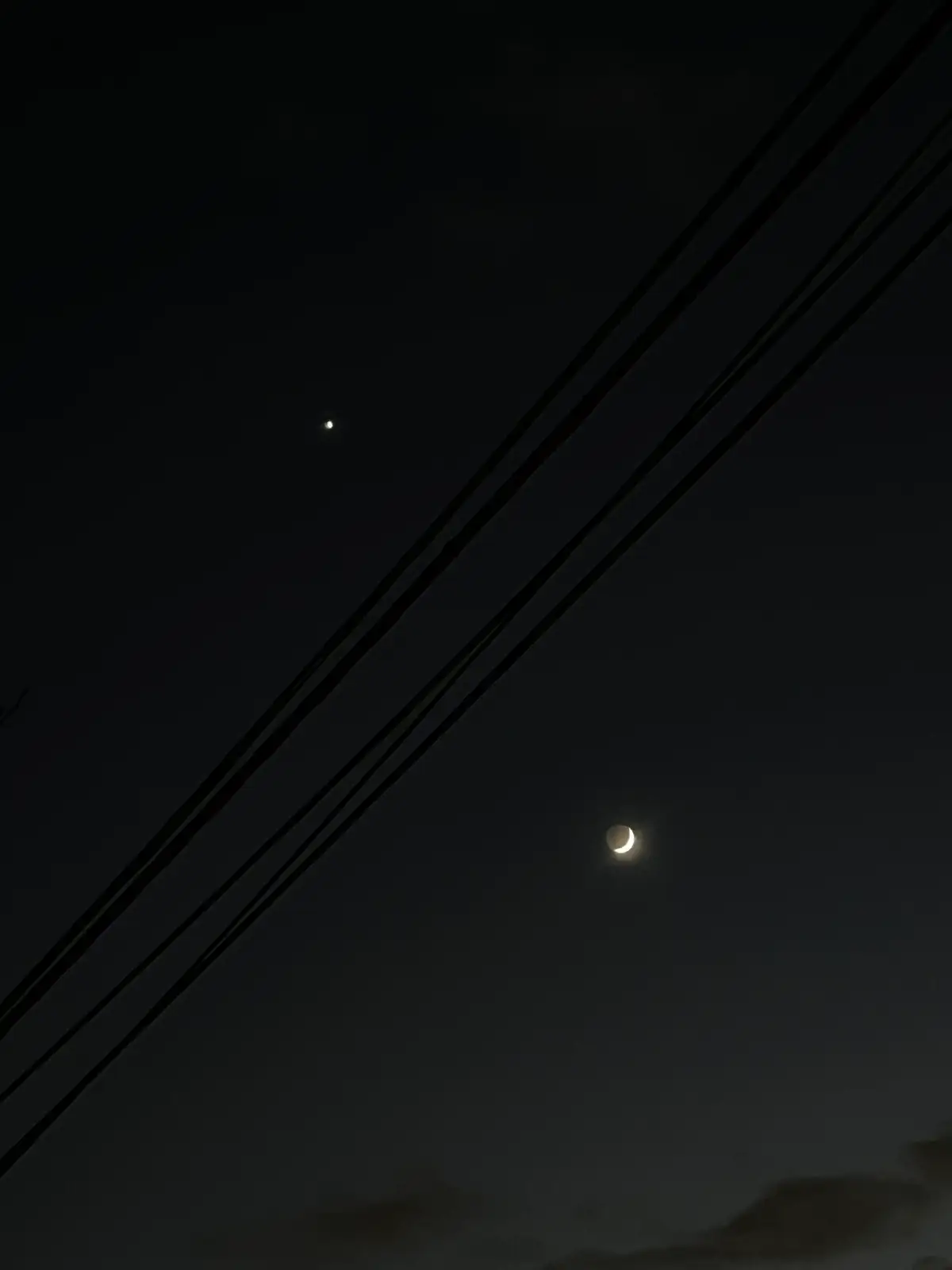
A low-angle, upward-looking photograph captures a serene nocturnal sky, dominated by deep indigo-black hues at the top, subtly transitioning to a muted, dusty charcoal and taupe at the very bottom edge, hinting at atmospheric haze or light pollution near the horizon. In the mid-frame, slightly below and to the right of the central vertical axis, a slender crescent moon glows with a brilliant, cool white to silvery luminescence, its right side illuminated against the vast darkness. The moon's surface appears smooth, lacking discernible craters or textures from this distance. Above and slightly to the left of the moon, a singular, intensely bright celestial object, likely a planet such as Venus (Venus vesper) or Jupiter (Jupiter jovis), or a prominent star, gleams as a sharp, radiant pinpoint of white light. Cutting diagonally across the upper and mid-portions of the frame, from the upper-left corner towards the lower-right, are five distinct, taut utility wires or power lines. These cables appear as sharply defined, matte black or very dark charcoal grey linear elements, forming a strong graphic silhouette against the celestial backdrop. They are evenly spaced and run parallel to each other, creating a leading line effect. At the extreme bottom edge of the image, a narrow band of dark, amorphous cloud formations is visible, rendered in muted taupe and deep charcoal grey tones, faintly illuminated from below, suggesting an unseen ground-level light source. The photograph exhibits an expansive depth of field, rendering both the distant celestial bodies and the closer utility wires in sharp focus, implying a wide-angle lens or a small aperture setting. The atmosphere appears remarkably clear, allowing for crisp visibility of the celestial objects, with no discernible humidity or temperature indicators. No living organisms, architectural structures, or readable text are visible within the frame.