View High-Res Still Frame
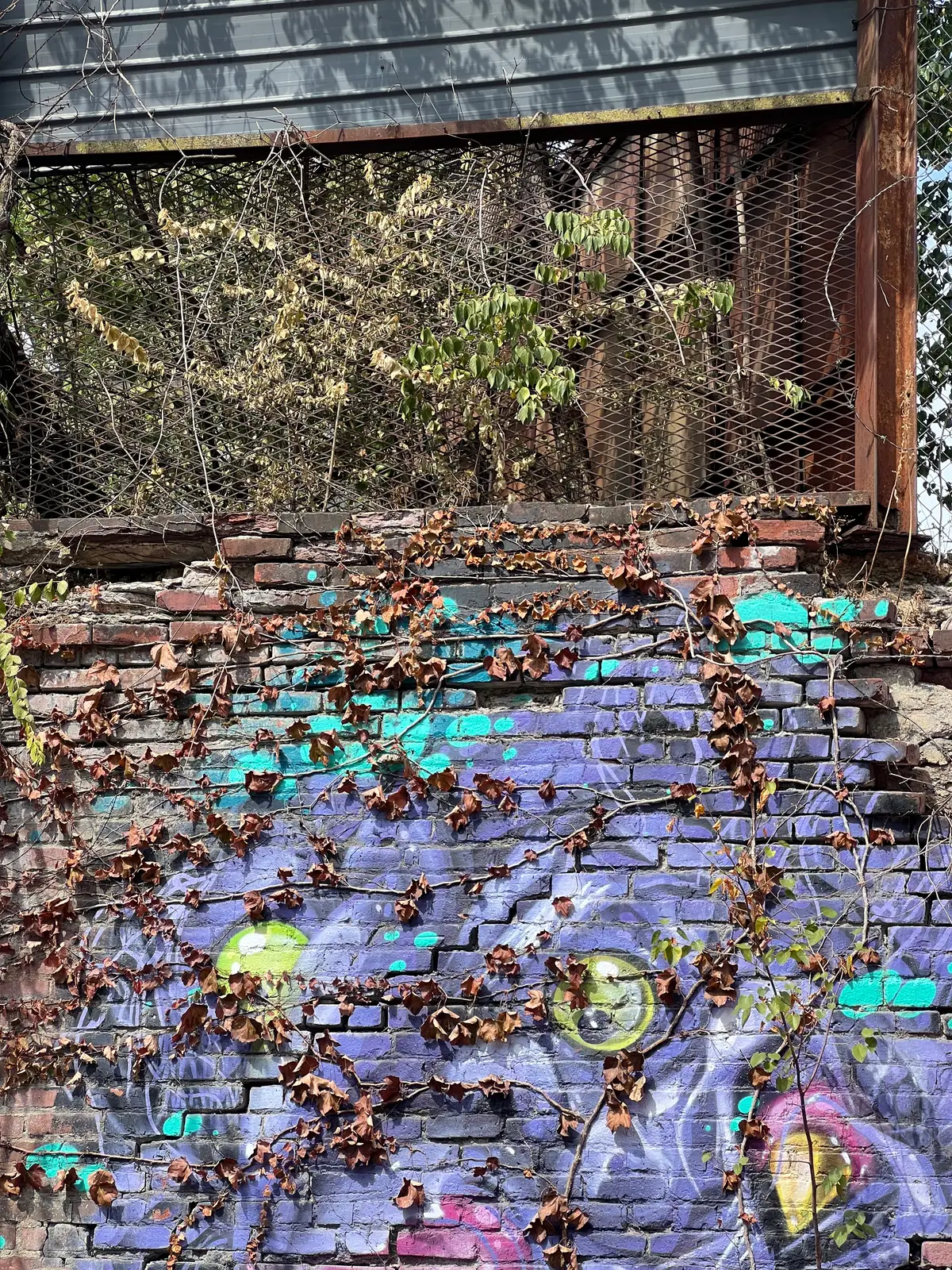
Where street art and nature intertwine.
The photograph presents a forensic close-up view of an urban scene dominated by a highly textured, decaying brick wall in the midground, heavily adorned with vibrant graffiti and tenacious climbing vines. Licensable motion asset by...
Read Full Description
The photograph presents a forensic close-up view of an urban scene dominated by a highly textured, decaying brick wall in the midground, heavily adorned with vibrant graffiti and tenacious climbing vines. The perspective is frontal, slightly angled upwards, capturing the stark contrast between human artistry and natural reclamation amidst dilapidation. The focal plane is sharply fixed on the brick wall and its immediate coverings, with a soft, pleasing bokeh rendering the background vegetation slightly out of focus. The lower two-thirds of the image are comprised of a common brick masonry wall, exhibiting significant signs of age and neglect. The bricks themselves are a mix of earthy terracotta, burnt sienna, and muted russet tones, with many individual units chipped, fractured, and eroded, revealing their porous, sandy texture. The mortar joints, once a creamy gray, are now heavily degraded, creating deep crevices that accentuate the individual brick forms. Overlaying this textured canvas is a large-scale graffiti mural, predominantly featuring a stylized animal face, possibly an owl or a feline, characterized by striking, spherical eyes. The graffiti utilizes a vivid palette: the background is a rich, electric violet and indigo, interspersed with vibrant patches of cerulean and teal that suggest fur or feathers. The large, luminescent eyes are rendered in an intense cadmium yellow, outlined with a deeper olive green, creating an almost glowing effect. Accents of hot pink are visible around the lower part of the face. Clinging tenaciously to the brickwork, both over and around the graffiti, are the woody stems of a climbing vine, likely Boston Ivy (Parthenocissus tricuspidata) or Virginia Creeper (Parthenocissus quinquefolia). The majority of these vines are in a dormant or dead state, their slender, gnarled tendrils covered in countless desiccated, crinkled leaves, uniformly colored in shades of amber and rust-brown, providing a stark organic texture against the painted brick. A few small clusters of vibrant celadon green leaves hint at resilient new growth amidst the autumnal decay. Above the brick wall, occupying the upper third of the frame, is a section of a dilapidated building structure. The uppermost part consists of weathered horizontal siding, possibly wood or corrugated metal, painted or stained a dark charcoal gray or deep sepia, showing patches of fading and discoloration. Beneath this siding, a large opening is secured by two distinct metal grates. To the left, a fine-gauge, dark metal mesh provides a dense, intricate pattern. To the right, a coarser, more openly spaced metal grate, heavily corroded, displays a distinct rust orange and ferrous brown patina, its bars bent and distorted in places. Behind these grates, a dense thicket of unidentifiable deciduous urban pioneer plants, likely Tree of Heaven (Ailanthus altissima) or various Sumac (Rhus) species, flourishes. Their foliage ranges from a pale chartreuse to a darker olive green, with some yellowish-brown leaves indicating early autumn or stress. The lighting is soft and diffused, characteristic of an overcast day or a deeply shaded urban canyon, minimizing harsh shadows and allowing the vibrant colors of the graffiti to stand out without glare. The overall atmosphere evokes a sense of forgotten urban spaces, where nature slowly reclaims human constructs, interspersed with spontaneous artistic expression. No discernible text, signage, or animal life is visible.