Read Full Description
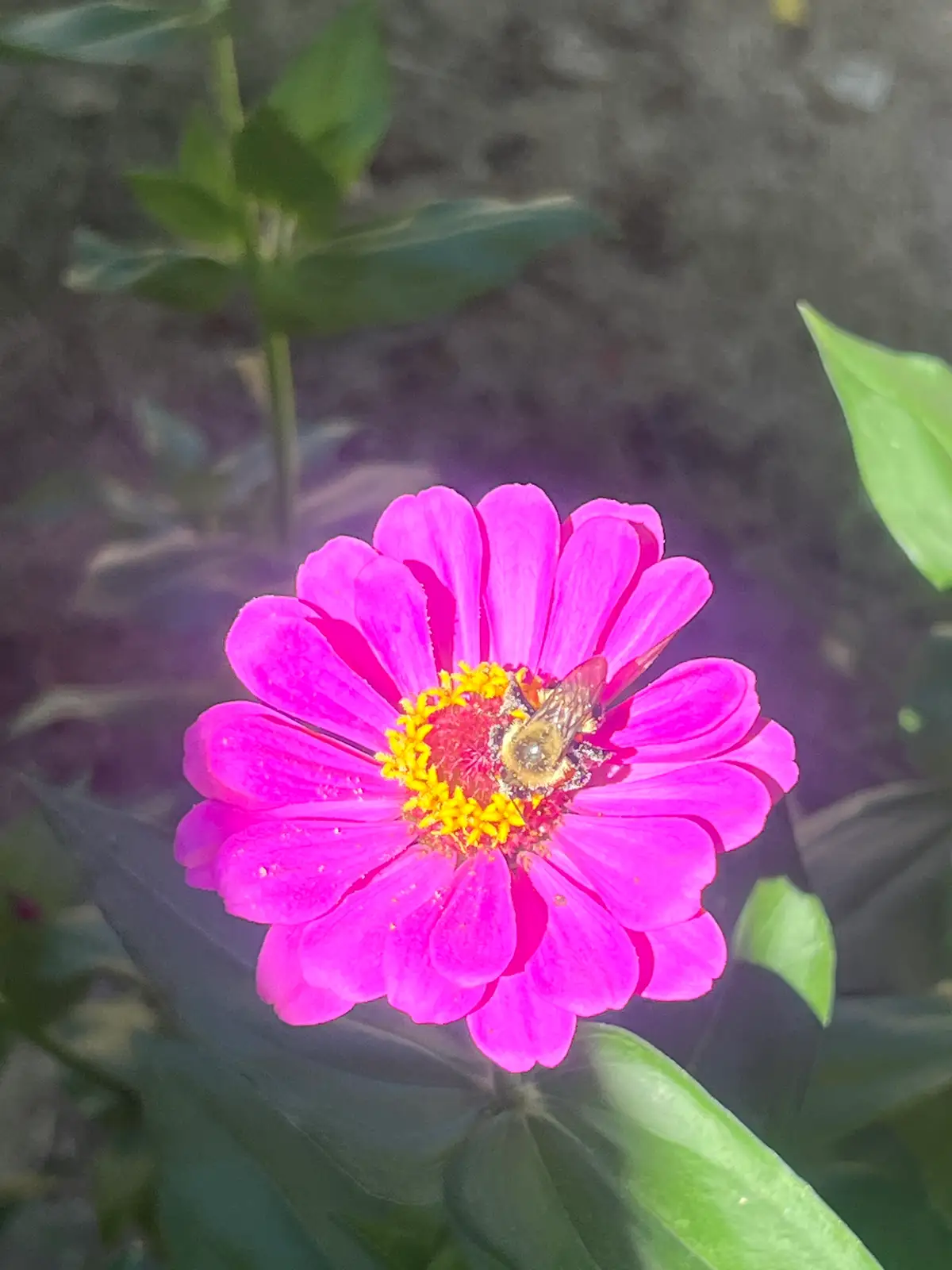
A highly detailed, macro-level photograph captures a vibrant Zinnia elegans (common garden zinnia) flower, actively being pollinated by a European honey bee (Apis mellifera). The Zinnia dominates the central and lower-right portion of the frame, presenting a spectacular display of fuchsia-pink ray florets. These individual petals are broadly spatulate, with smooth, entire margins, and exhibit a velvety texture under the direct sunlight, showing slight variations in hue from a brighter magenta near their tips to a deeper rose at their base where they meet the tightly packed disc florets. The central disc is a dense cluster of cadmium-yellow to saffron-orange tubular disc florets, many of which are laden with rich, golden-yellow pollen grains. The bee, a robust specimen of Apis mellifera, is positioned head-down amidst these disc florets, its hairy, black and golden-yellow banded abdomen slightly elevated. Its six legs are actively sifting through the pollen, and its translucent, iridescent wings are folded neatly along its back, showing delicate venation. The insect's compound eyes are a glossy, dark brown. Surrounding the main bloom, several ovate to lanceolate Zinnia leaves, displaying a deep emerald green, are visible. Some leaves in the immediate foreground and background are softly blurred into a rich olive-green bokeh, indicating a very shallow depth of field. The lighting is direct and intense, suggesting bright midday sun, which creates strong highlights on the bee's fuzzy thorax and the flower's petals, enhancing their vivid colors. The background is a pleasing, soft-focus tapestry of dark green and shadowed areas, subtly indicating dense garden foliage. No architectural elements, text, or specific ground cover are discernible. The camera perspective is slightly elevated, looking down into the flower, focusing sharply on the bee and the central disc of the Zinnia.