Read Full Description
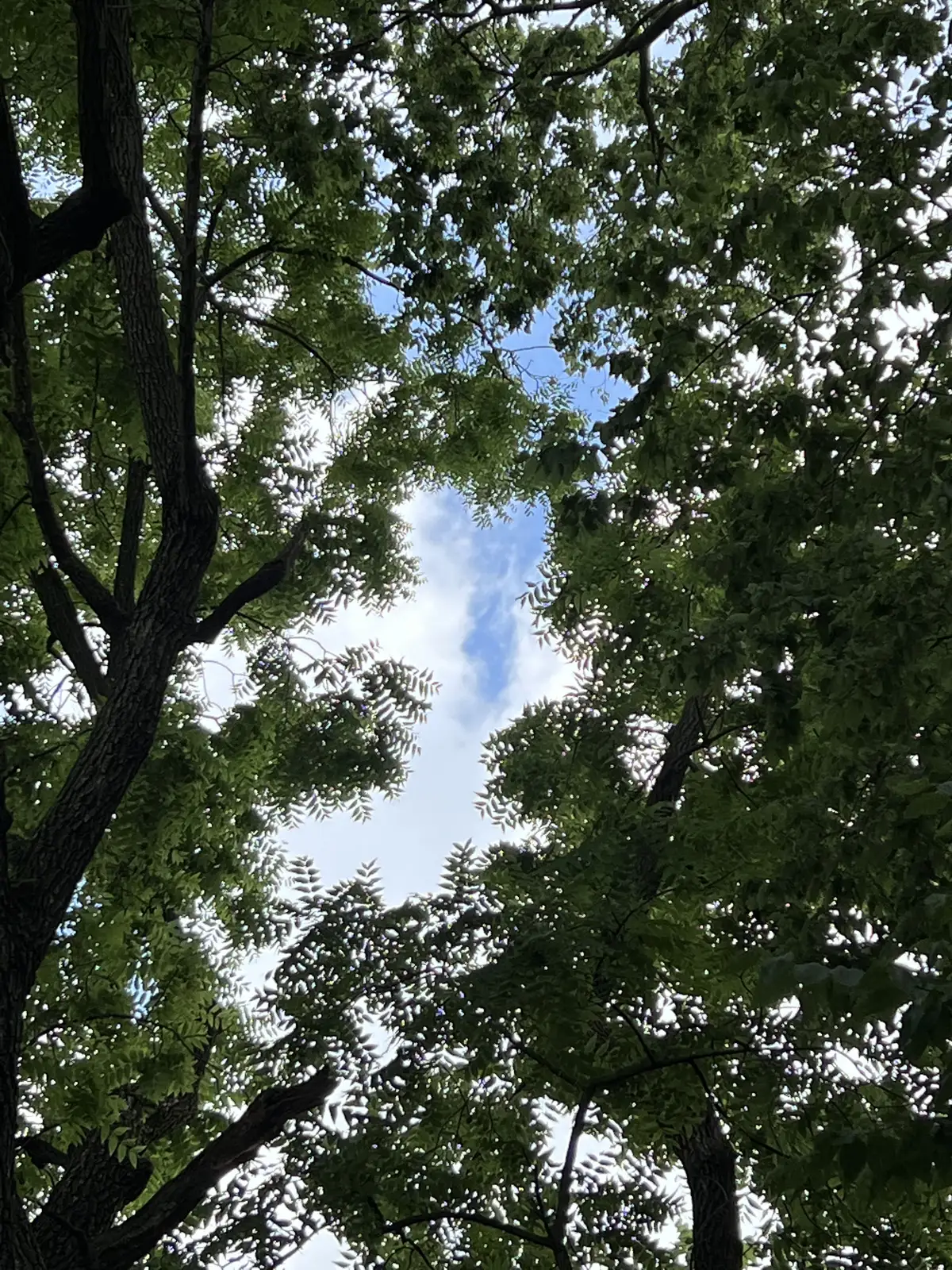
A dramatic low-angle photograph captures a vibrant, upward perspective through the dense, interlocking canopy of mature deciduous trees against a luminous sky. The primary subjects are the richly textured foliage and robust branches, forming a natural, irregular frame around a central opening. The trees are identified as likely Black Locust (Robinia pseudoacacia), characterized by their pinnately compound leaves, each comprising multiple small, ovate to elliptical leaflets arranged along a central rachis. The individual leaflets exhibit entire (smooth) margins and are a lively spectrum of greens: from brilliant emerald and lime green where directly touched by sunlight to deeper, more subdued forest and jade green in shaded areas. The foliage appears mature and luxuriant, indicative of peak growth during late spring or summer. The thick, gnarled branches, particularly those in the foreground and midground, display deeply furrowed bark with tones ranging from dark charcoal grey to warm sepia and earthy umber, suggesting significant age and resilience. No epiphytic plants, fungi, or insects are visibly clinging to the bark or leaves. Through the irregular 'window' in the canopy, a clear, brilliant cerulean blue sky is visible, dotted with scattered, soft white cumulus clouds with wispy edges, hinting at a fair-weather day. The camera's perspective is directly upwards, emphasizing the towering scale of the arboreal architecture. The depth of field is moderately deep, allowing both the intricate details of the nearer leaves and the distant clouds to remain in reasonable focus, although some of the closest leaf clusters exhibit a subtle, creamy bokeh. Bright, overhead natural light creates dynamic highlights and dappled shadows across the leaves, enhancing their three-dimensional quality and varied textures. No man-made structures, animals, readable text, or signs are present within the frame. The overall atmosphere is one of serene natural grandeur.