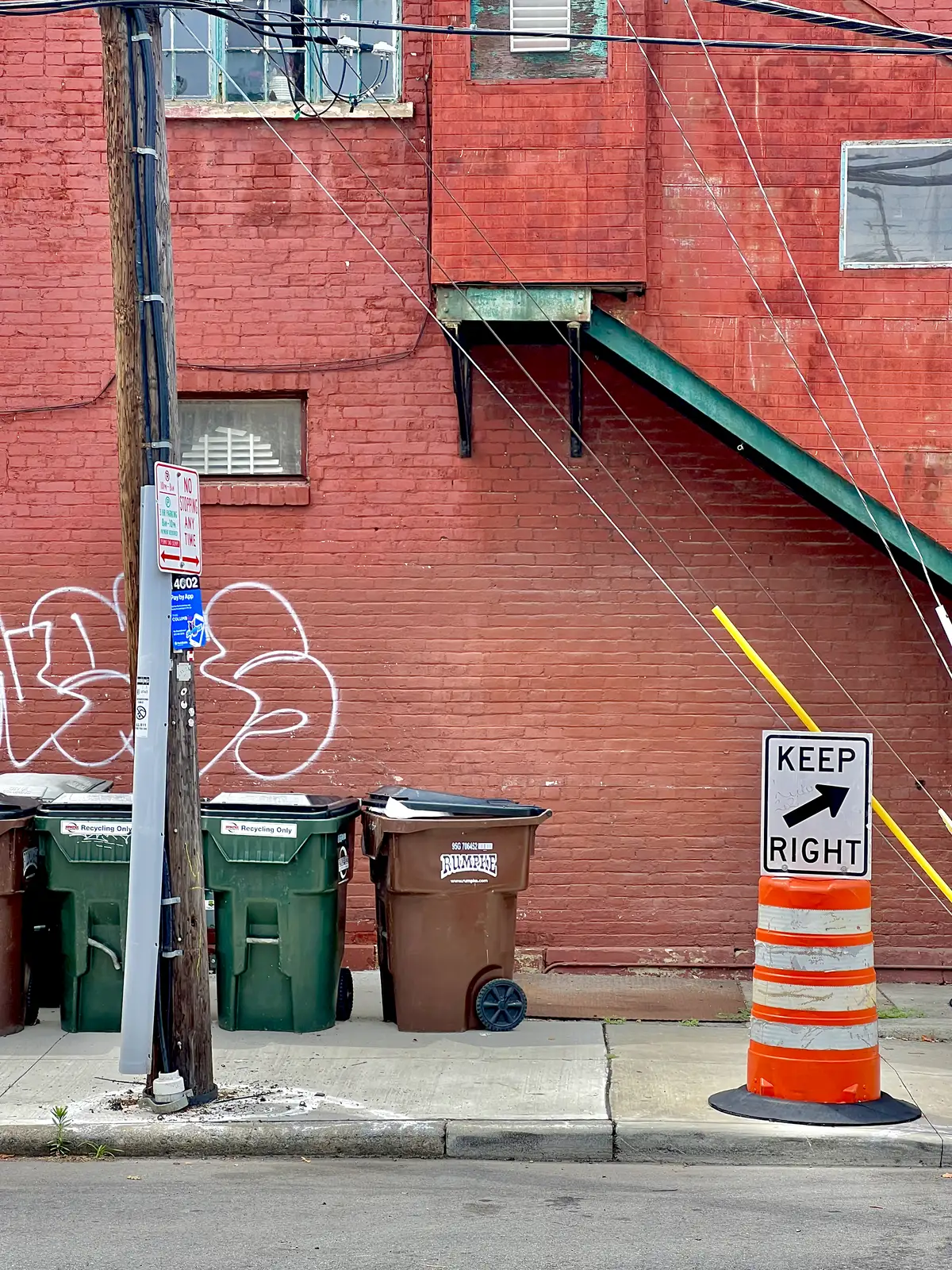
Urban layers: brick, wires, and street signs.
The image captures a vibrant, high-contrast, eye-level street-level perspective of an urban alleyway or a utilitarian rear building facade on a clear, bright daytime. Licensable stock photo by Dylan Stanley.
Read Full Description
The image captures a vibrant, high-contrast, eye-level street-level perspective of an urban alleyway or a utilitarian rear building facade on a clear, bright daytime. The focal plane is sharp across the mid-distance, encompassing the foreground utility pole and traffic cone, and extending with good clarity to the background brick building, indicating a moderate depth of field. The lighting is direct and strong, likely from overhead and slightly to the left, creating distinct shadows that stretch towards the right of the frame, suggesting a sunny day with minimal atmospheric haze. No specific plants, animals, insects, or fungi are identifiable within the frame. A sliver of pale blue-gray sky is reflected in an upper window. In the left foreground, a heavily weathered, dark brown wooden utility pole, exhibiting deep vertical furrows and cracks, stands prominently. It is densely entangled with a complex network of taut and sagging dark gray and black electrical and telecommunication wires that crisscross the upper half of the frame, connecting to the pole and extending towards the background building. Attached to the pole at roughly eye-level are several rectangular metal signs: a topmost white 'NO PARKING' sign with a red circle and diagonal line, a blue sign below it with illegible white text, and a partially obscured smaller white sign below that, possibly indicating a 'TOW AWAY ZONE'. To the right of the pole, a trio of wheeled, lidded, rectangular plastic residential-style garbage bins are lined up on a light gray concrete sidewalk. Two bins are a dark forest green, showing scuffs and dirt, one with a faint white label. The third, positioned slightly to the right, is a medium brown. The concrete sidewalk itself is stained with darker smudges and patches of greenish discoloration, indicative of algae or moss growth within its crevices. A narrow strip of dark gray asphalt street is visible along the very bottom left, with faint remnants of white road markings. The dominant background is a multi-story building wall, constructed from aged, rough-textured common red bricks, displaying a rich palette of burnt sienna, rust red, and maroon tones, interspersed with light gray mortar lines. The brickwork shows signs of weathering, including staining. On the lower left of this wall, white spray-painted graffiti, depicting a stylized 'B' and an accompanying illegible tag, contrasts starkly with the brick. Several rectangular windows with multiple panes are visible: two on the left side (one upper, one lower), reflecting pale blue-gray light, and a larger one on the upper right. An aged, shallow, angled metal canopy, painted a deep celadon green, extends horizontally from the building, supported by dark metal diagonal braces that appear corroded. Below this canopy, a section of a dark forest green metal fire escape or service stair system descends diagonally towards the right. In the right foreground/midground, a bright safety orange plastic traffic cone with prominent reflective white and orange horizontal stripes is positioned, anchored by a circular black rubber base. Affixed to its apex is a rectangular white sign with a black border, bearing the bold black text "KEEP RIGHT" and a clear black arrow pointing diagonally upwards and to the right.