Read Full Description
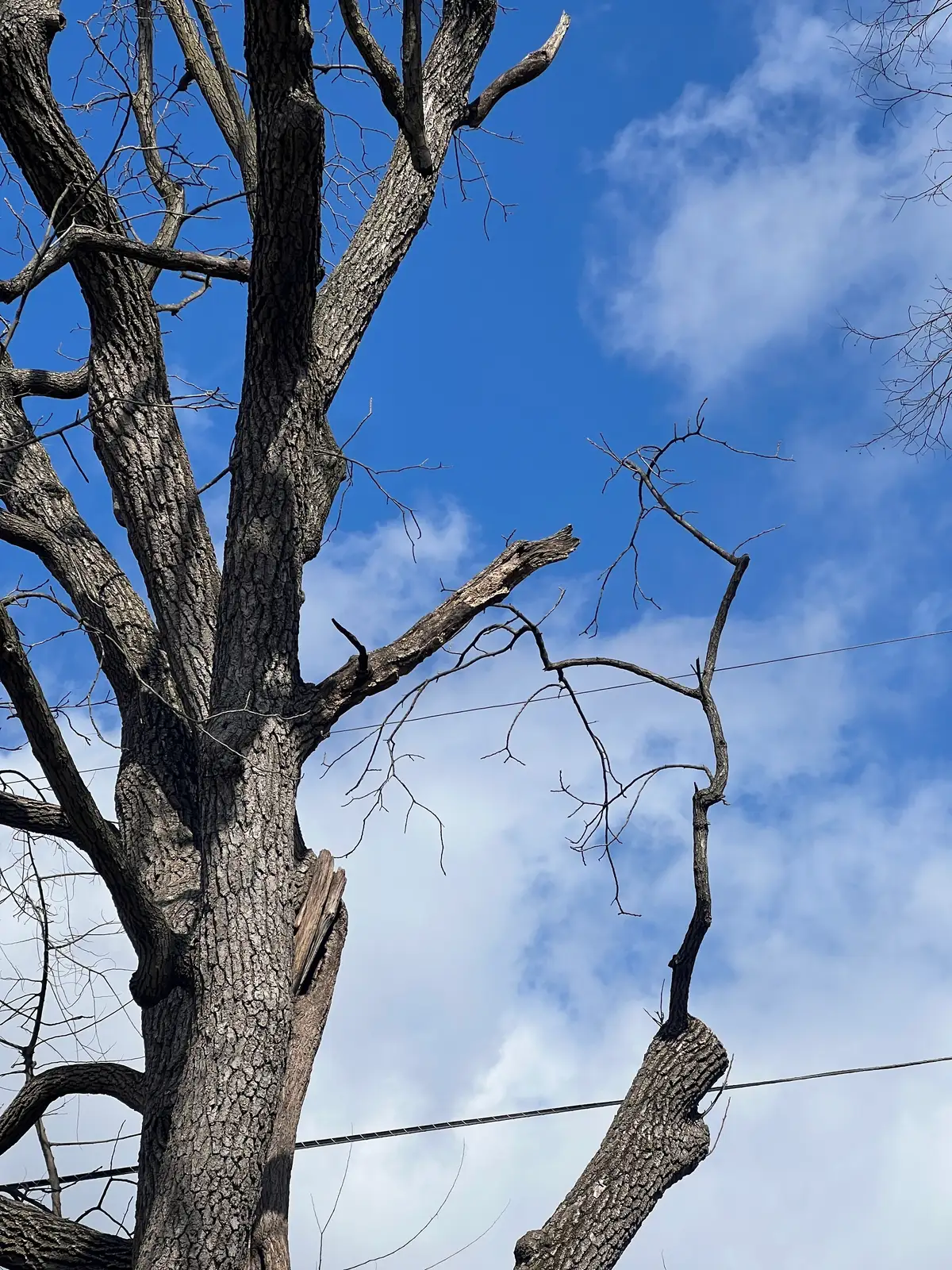
The photograph captures a striking vertical composition dominated by the bare, gnarled branches and trunk of a mature deciduous tree, likely a species such as an oak (Quercus) or a maple (Acer), though precise identification is difficult without foliage. The tree occupies the left two-thirds of the frame, extending from the bottom edge to beyond the top, its imposing form a study in skeletal resilience. Its bark is a complex tapestry of deeply furrowed texture, presenting a variegated palette of cool, desaturated taupe, warm sepia, and muted charcoal greys, with hints of very dark olive green subtly residing in the deepest crevices where shadows linger. Sunlight, emanating from a clear midday sky, illuminates the upper surfaces of the larger branches, creating subtle highlights and defining the intricate, rugged contours of the bark. Numerous branches extend upwards and outwards, forming an intricate, skeletal network that appears almost sculptural against the sky. Several larger limbs, particularly in the lower and middle sections, show clear evidence of past pruning or natural breakage, with some jagged, splintered ends visible, revealing lighter, exposed sapwood, hinting at the tree's advanced age and enduring strength. Many smaller, finer twigs extend from the larger branches, entirely devoid of leaves, strongly suggesting a late autumn, winter, or early spring season. The camera's perspective is angled sharply upwards from a low vantage point, emphasizing the majestic height and expansive reach of the tree and creating a sense of grandeur. The background is a vibrant, clear cerulean blue sky, punctuated by an array of fluffy, cotton-like cumulus clouds. These clouds are predominantly brilliant, crisp white with soft, wispy edges, but also exhibit subtle undertones of light silver-grey, particularly on their lower and shadowed sides, indicating their three-dimensional form and adding depth to the atmospheric conditions. Both the tree and the clouds are in sharp focus, suggesting a relatively deep depth of field across the scene. A few thin, dark utility wires, possibly telephone or cable lines, traverse the lower third of the frame horizontally, partially obscured by the lower branches of the tree, subtly introducing a touch of human infrastructure into the natural scene. No ground, specific fauna, or discernible text or signage is visible within the frame.