View High-Res Still Frame
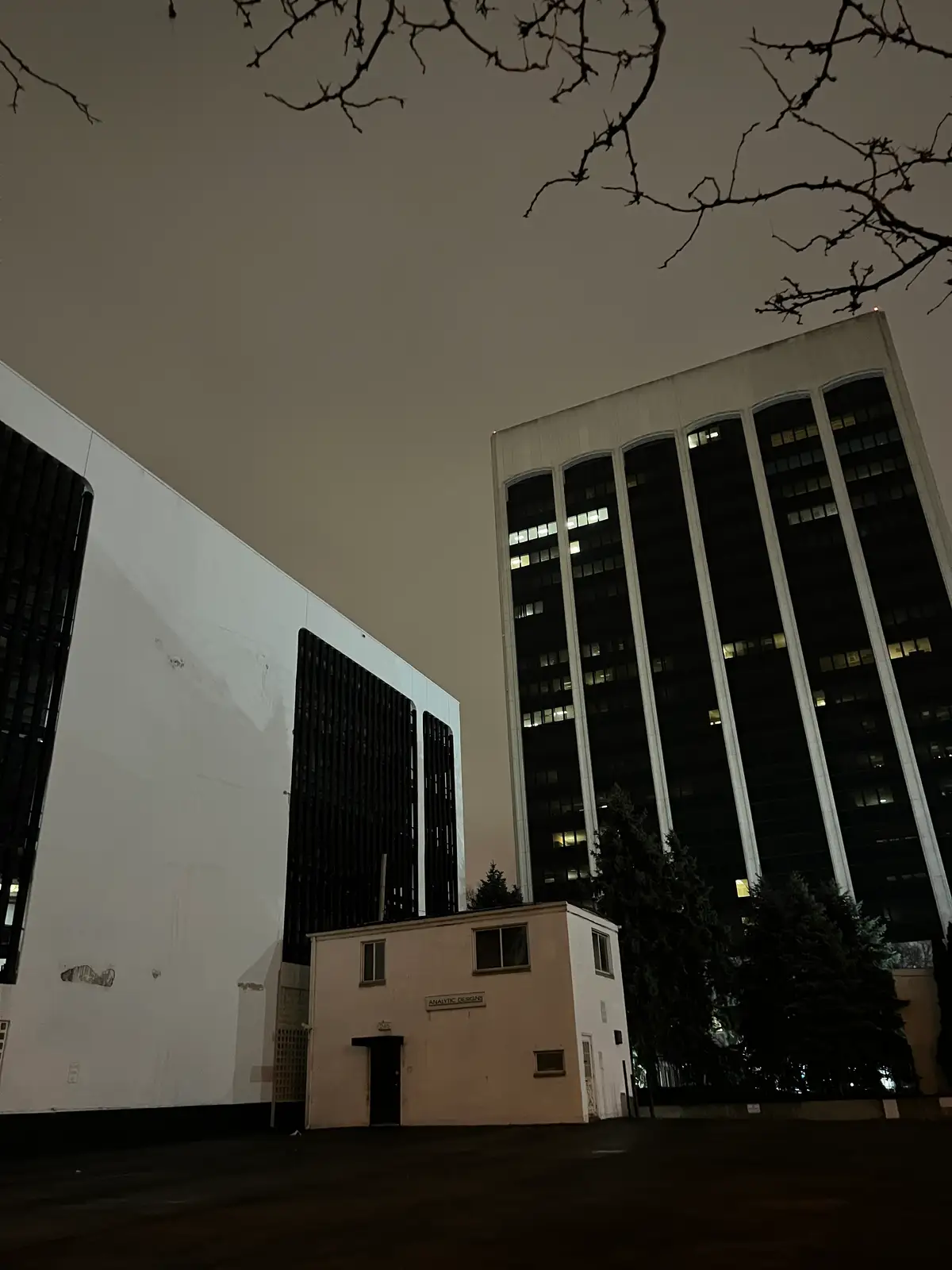
Urban geometry glowing after dark.
A low-angle, nighttime photograph captures a stark urban landscape dominated by three distinct buildings under an expansive, uniformly overcast sky. Licensable motion asset by Dylan Stanley.
Read Full Description
A low-angle, nighttime photograph captures a stark urban landscape dominated by three distinct buildings under an expansive, uniformly overcast sky. In the extreme foreground, several prominent, bare deciduous tree branches, likely from an oak (Quercus) or maple (Acer) species given their gnarled, dark brown to sepia-toned bark, slice into the top of the frame. These branches appear slightly out of focus with a soft bokeh, indicating a shallow to moderate depth of field or a focal plane centered on the structures further back. Their intricate, skeletal forms provide a natural frame against the gloomy sky. At the base of the image and serving as a central anchor, a single-story utility building is prominent. Its facade, constructed from painted stucco or rendered concrete, displays an aged, off-white to pale cream hue, marred by subtle grime and discoloration that suggest years of weathering. The building features two small, rectangular, dark-paned windows on its visible side and a single, dark, recessed pedestrian door on the left. Above the door and between the windows, an indistinct, possibly weathered, alphanumeric sign or label is present, though too blurry to decipher. The roofline is flat and unadorned. Behind and to the left of the utility building, a towering, rectilinear modernist high-rise dominates the left portion of the frame. Its expansive, flat facade is clad in a pristine, stark white material, possibly pre-cast concrete or a smooth paneling system. Numerous dark, elongated rectangular windows or architectural panels are recessed vertically along its surface, creating a rhythmic, minimalist pattern. To the right of the utility building and extending upwards into the mid-right, an even taller, imposing Brutalist- or late-modernist-style skyscraper stands. Its dark, almost charcoal-black facade is characterized by strong vertical mullions or deep fins, creating a sense of powerful linearity. Between these dark vertical elements are numerous bands of reflective or dark-tinted glass. Many of the windows across its upper and mid-levels glow with a warm, almost burnt sienna or deep amber artificial light, piercing through the otherwise somber palette and providing a stark visual contrast and a sense of human presence within the cold, imposing architecture. The immediate ground surface beneath the utility building and extending across the bottom of the frame is a dark, paved area, likely asphalt or concrete, appearing almost black or very dark charcoal gray under the low light. Hints of darker, unidentifiable low-lying vegetation or bare earth are visible immediately around the base of the small utility building. The entire upper portion of the image is filled with an expansive, uniformly overcast sky, glowing with a muted, dull slate-gray to sepia-toned hue, indicative of significant urban light pollution filtering through a thick cloud layer. No celestial bodies are visible. The scene is illuminated primarily by artificial light from the building windows, casting a warm glow that contrasts with the cool, dim ambient light of the overcast night. Shadows are soft and diffused due to the atmospheric conditions. The photograph is taken from an extreme low-angle perspective, looking sharply upwards, which exaggerates the monumental scale and presence of the high-rise buildings, making them appear to converge towards the top of the frame. The overall impression is one of stark urban grandeur, mystery, and a slightly melancholic mood.