Read Full Description
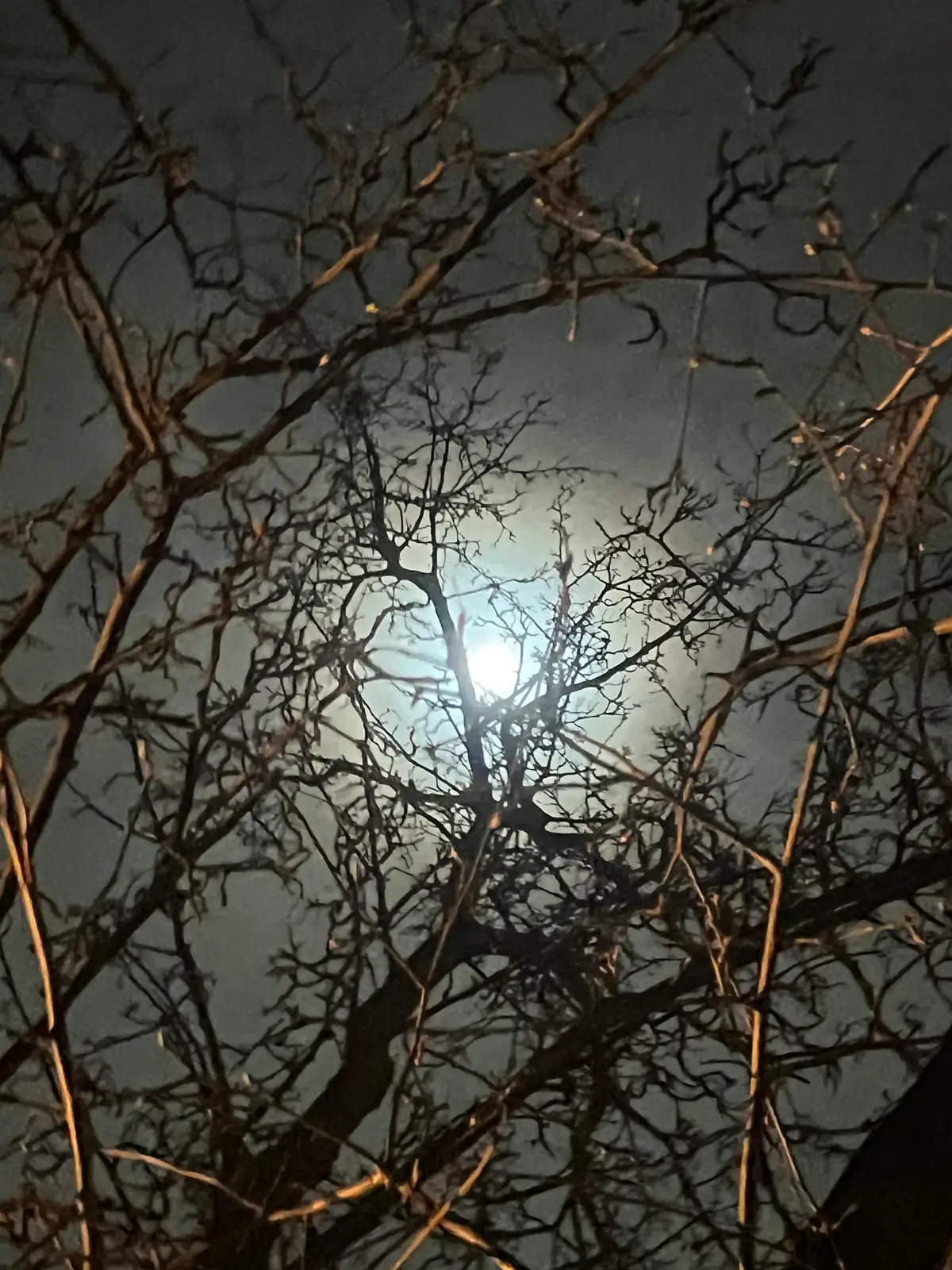
An evocative, upward-gazing, vertical composition captured at night, presenting a radiant full moon partially obscured and intimately framed by the intricate, skeletal network of bare, dormant deciduous tree branches. The camera perspective is low-angle, looking directly skyward, with the moon centrally positioned. The foreground and midground are dominated by a complex, dense web of gnarled branches and numerous fine twigs, strongly suggesting a mature deciduous species such as an oak (Quercus) or maple (Acer), which have shed their leaves for the colder seasons. The bark on the thicker, older branches exhibits a deeply furrowed, craggy texture, appearing in shades of deep umber, burnt charcoal, and almost obsidian against the brilliant light. Smaller, younger twigs are comparatively smoother, presenting a darker, sleeker surface. Extremely delicate, almost imperceptible strands of silvery, translucent spider silk (Araneae family) can be discerned catching the moonlight on some of the finer upper-right branches, shimmering faintly and adding to the intricate detail. The moon, the primary light source and focal point, appears as a perfectly circular orb of stark white and brilliant cerulean light. Its intense luminosity creates a powerful atmospheric glow, almost a halo, of diffuse light that extends outwards, transitioning to softer, pale amber and yellowish tones at its edges. This radiant core and diffused halo are indicative of strong atmospheric scattering or a slight haze, suggesting a humid or misty night rather than a perfectly clear sky. The background sky is a gradient of deep indigo and charcoal grey, subtly illuminated by the moon's presence, further hinting at light cloud cover or atmospheric moisture typical of a cold night in late autumn or winter. The overall depth of field is extensive, rendering the complex lacework of the tree branches with significant sharpness across the frame, while the distant, overpowering moon remains an intensely bright and visually central element.