View High-Res Still Frame
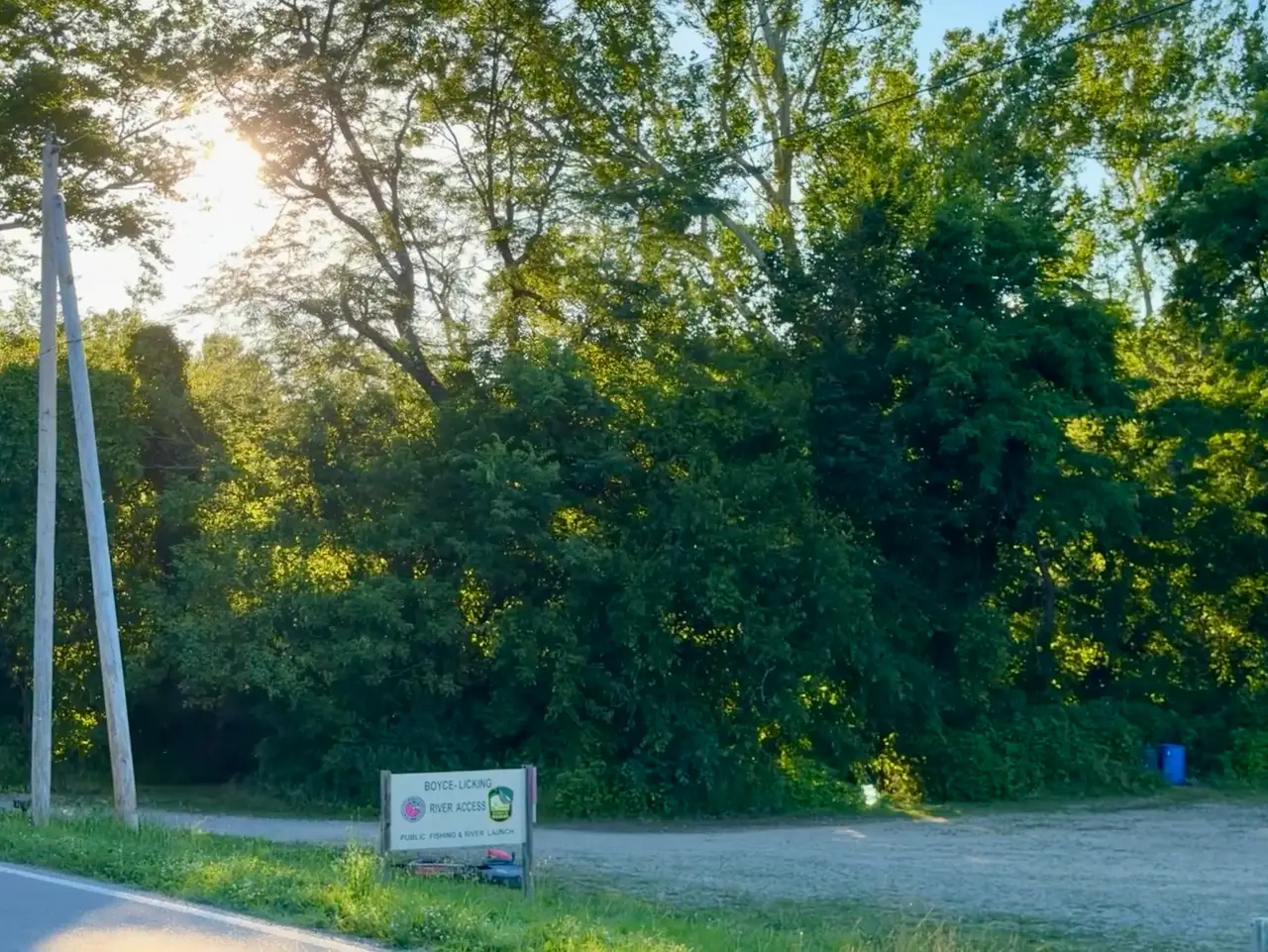
Warm light and lush greens invite river exploration at Boyce-Licking.
An outdoor, eye-level photograph captures a verdant, sun-drenched rural landscape during the late afternoon golden hour. Licensable motion asset by Dylan Stanley.
Read Full Description
An outdoor, eye-level photograph captures a verdant, sun-drenched rural landscape during the late afternoon golden hour. The composition is bisected horizontally by a paved road at the lower left, leading into a gravel or dirt access area on the right, and vertically by two weathered wooden utility poles in the far left foreground. The poles, likely treated pine (Pinus spp.) or oak (Quercus spp.) given their pale, uniform coloration and vertical orientation, show subtle textural irregularities from age but no significant rot or decay. The sky, a clear, brilliant cerulean blue fading to a hazy, sun-bleached white around the direct light source, occupies the upper portion, with the sun itself, a vibrant amber and golden yellow orb, creating a prominent lens flare through the dense foliage of a mature deciduous tree (likely a species of Populus, such as an Eastern Cottonwood (Populus deltoides) or other large-leaved tree) on the upper left. This backlighting illuminates the leaves with a bright chartreuse and lime green glow, contrasting with the deeper forest green and olive green of the shadowed undergrowth and background trees. In the midground, slightly to the right of center, a white rectangular sign with a wooden frame is visible. The sign reads "BOYCE-LICKING RIVER ACCESS" in a dark, sans-serif font. Below this, two logos are present: a pink circular logo depicting a fish on the left, and a green, stylized leaf or tree logo on the right. Beneath these, smaller text reads "PUBLIC FISHING & RIVER LAUNCH". The sign's surface appears slightly worn, but the text is fully legible. The immediate foreground features short, bright green grass (likely a mix of common lawn grasses like Kentucky bluegrass (Poa pratensis) or tall fescue (Festuca arundinacea)) growing along the edge of the asphalt road. The road itself is a dark, uniform charcoal gray. Beyond the sign, the ground transitions to a lighter, granular beige and light gray gravel path or parking area, which then meets a thick, unbroken wall of diverse riparian vegetation. This includes various mature deciduous trees (likely a mix of maples (Acer spp.), oaks (Quercus spp.), and possibly hickories (Carya spp.)) with some denser, darker green patches that might indicate evergreen shrubs or smaller conifers like Eastern Red Cedar (Juniperus virginiana) further back. The leaves exhibit varying shades of green, from the intensely lit, almost translucent chartreuse to deep, shadowed emerald and olive green. In the far right midground, nestled against the foliage, a single cerulean blue plastic barrel, likely a standard 55-gallon drum, is visible, partially obscured by the surrounding vegetation. No animals or insects are explicitly visible, though the dense vegetation suggests a thriving ecosystem. The overall depth of field is moderate, with the foreground elements like the road and lower part of the sign relatively sharp, while the background trees and light display a soft, painterly bokeh, enhancing the ethereal quality of the golden hour light. The atmosphere appears clear and warm, with no visible haze or fog apart from the light effects. The sunlight casts long, soft shadows, though the primary light source is directly facing the camera.