Read Full Description
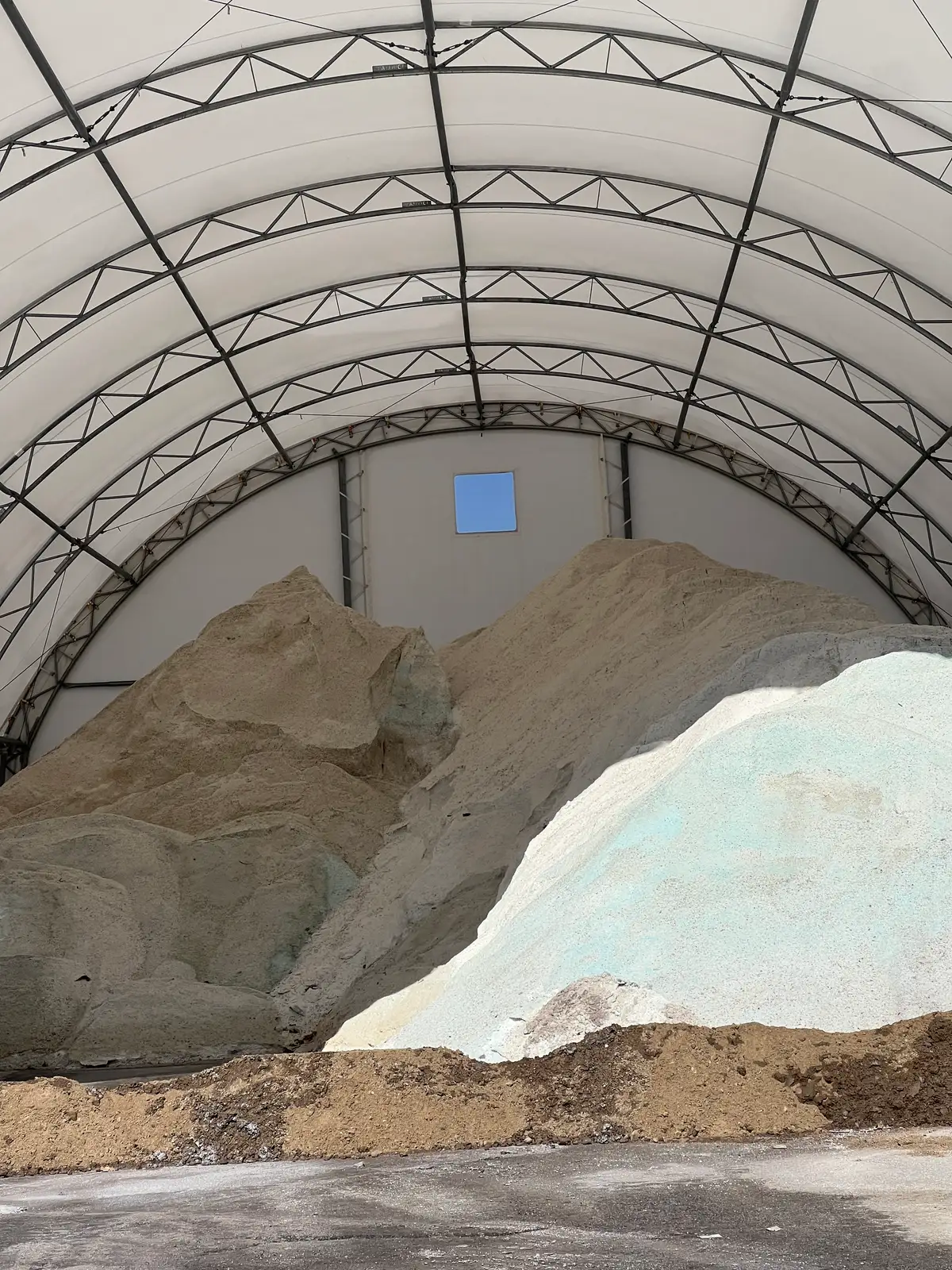
The photograph presents a compelling view into the cavernous interior of a large, arch-roofed industrial storage facility, likely designed for bulk materials such as road salt or aggregates. The dominant architectural feature is the building's tensile fabric roof, a bright, off-white, semi-translucent material stretched taut over a robust skeletal framework. This framework consists of a series of dark charcoal-grey or matte black tubular steel trusses, which form elegant, repetitive arches spanning the width of the structure. These trusses are visibly constructed from smaller, intersecting tubular members, creating a complex web of triangular and rectangular geometries that provide structural integrity and define strong, curving leading lines towards the roof's apex. The fabric allows a soft, diffused daylight to penetrate, creating an even illumination across the scene, though the stark contrast between the luminous white fabric and the dark, shadowed steelwork is visually striking. Near the central peak of the arch, a single, small, perfectly rectangular opening offers a direct glimpse of the outside, revealing a patch of clear, deep cerulean blue sky, indicating bright, fair weather conditions beyond the confines of the building. The midground and foreground are overwhelmingly dominated by immense, sculpturally shaped piles of granular bulk materials. The most prominent mass, situated on the left and extending towards the center, is a vast heap of finely granulated material, displaying a range of sandy beige, pale ochre, and off-white tones, characteristic of unprocessed road salt or construction-grade sand. Its surface is a textured tapestry of small ridges and valleys, suggesting recent deposition or movement by machinery. Adjacent to and partially merging with this pile, on the right side of the frame, is a distinct second mound. This material is visually captivating due to its striking pale aquamarine or mint green coloration, hinting at a specialized treated de-icing agent or a unique mineral compound. The granularity and irregular form mirror that of its beige counterpart. At the very bottom edge of the composition, serving as the immediate foreground and substrate for these towering piles, is a layer of dark, earthy brown material, appearing coarser and more compact, likely a base of dirt, compacted gravel, or another type of aggregate. The photographic perspective is low-angle, looking slightly upward into the vastness, effectively emphasizing the immense scale of both the storage structure and its contents. The depth of field appears comprehensive, keeping both the foreground materials and the overhead structure largely in sharp focus, with no significant bokeh. There are no discernible living organisms, readable text, or human artifacts beyond the industrial materials and structure itself, conveying a mood of functional utility and immense, almost sculptural, bulk.