Read Full Description
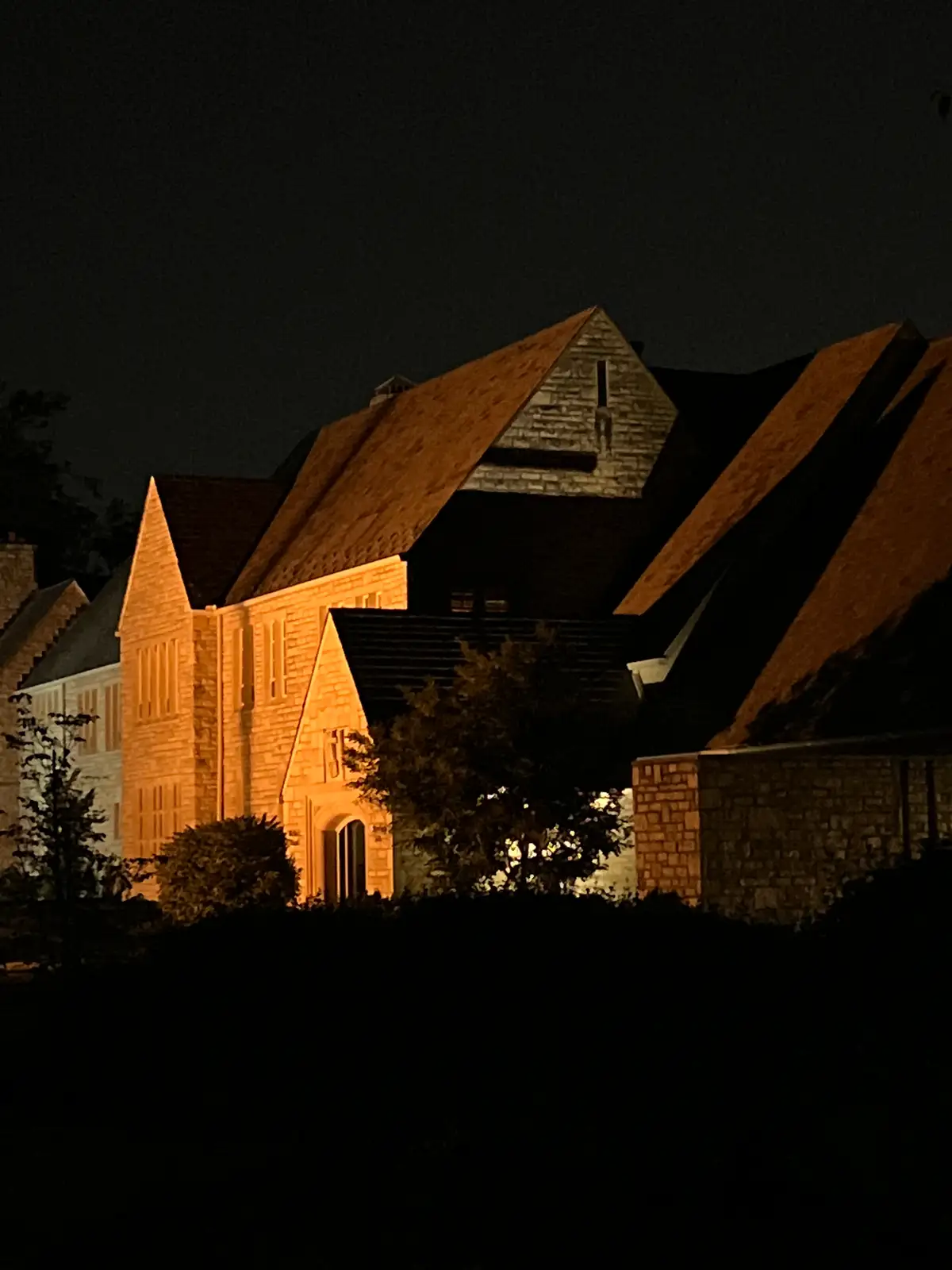
A dramatic, low-light nocturnal photograph captures a cluster of historic stone buildings under a deep, featureless black sky. The architecture, likely a blend of medieval and Tudor Revival styles, features steeply pitched roofs, prominent gables, and substantial masonry construction. The facades are crafted from rough-hewn cut stone, possibly a warm-toned limestone or sandstone, which glows in shades of amber, ochre, and burnt sienna where illuminated by unseen artificial light sources. The irregular texture of the stone is highly visible, with distinct mortar lines. The dominant roofs are covered in dark, possibly terracotta or slate, tiles or shingles, appearing in deep charcoal and muted brick red tones, their contours subtly defined against the darkness. A specific architectural detail, a cross-shaped timber framing element, is visible on one prominent gable. In the immediate foreground, a dense mass of unidentifiable deciduous foliage, likely bushes and smaller trees, creates a deep black silhouette that obscures the ground. In the mid-ground, a broadleaf tree, potentially a maple (Acer) or an oak (Quercus) given its rounded canopy, is partially illuminated by the warm light, showcasing its mature, vibrant green-gold leaves. Another darker, more compact shrub is partially visible to the right. The lighting is highly localized and dramatic, suggesting strategic up-lighting that creates a high-contrast scene with deep, soft shadows. The sky is an absolute black, devoid of any visible stars or light pollution. The camera perspective is slightly low, looking up at the illuminated structures, which are in sharp focus. The depth of field appears moderately shallow, with the foreground foliage and distant sky receding into soft, smooth bokeh. The atmospheric conditions indicate a clear, cool night. There is no readable text, signage, or visible living organisms other than the identified plant life.