Read Full Description
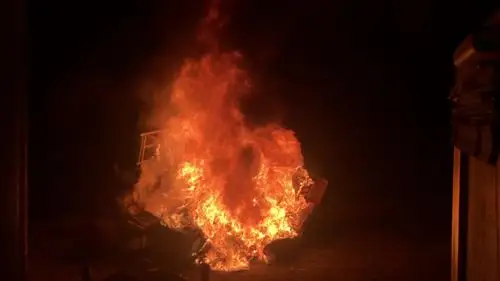
The image captures a dramatic, intense blaze dominating the central frame against a backdrop of profound, inky darkness, indicative of a moonless night. The fire, appearing to consume a significant pile of debris, erupts upwards in a turbulent column of vibrant vermilion, fiery orange, and saffron yellow flames, with streaks of deep crimson at its core. Individual flame tendrils, sinuous and constantly shifting, are sharply rendered, suggesting a shutter speed fast enough to capture their dynamic forms while still conveying their ceaseless motion. Glowing amber embers are visible within the heart of the conflagration, intermittently detaching and ascending with the turbulent heat currents. The focal plane is precisely set on the heart of the inferno, rendering the majority of the flames in sharp detail. No discernible bokeh is present, as the background recedes into an absolute, velvety black void. On the immediate left and right edges of the frame, dark, unadorned architectural elements act as monolithic framing devices. These appear as massive, vertical structures, possibly made of dark, unidentifiable masonry or stone, presenting a smooth yet shadowed surface texture. They suggest an enclosed space or a deep passage, emphasizing the isolated intensity of the fire. Their unlit surfaces are rendered in charcoal black, absorbing all ambient light and creating a stark contrast with the brilliant inferno. Beneath the towering flames, the ground, partially illuminated by the fire's radiant glow, appears as a dark, irregular surface, likely scorched earth, packed dirt, or asphalt. Its texture is rough and uneven, with subtle shadows cast by minor undulations, visible only in the immediate vicinity of the intense light source. Whisps of dark, sooty smoke, barely discernible against the black background, rise from the upper reaches of the blaze, subtly indicating the combustion of organic or cellulosic material. The overall perspective is a direct, eye-level or slightly low-angle shot, granting the fire a monumental, almost primal presence within the composition. The atmospheric conditions are still and clear, devoid of fog or rain, allowing the raw power of the fire and the absolute darkness to create a high-contrast, almost overwhelming visual impact. No living organisms, legible text, or specific architectural styles are identifiable beyond the generic dark structures.